

Ever typed “ring barer” and paused?
Or wrote “bearer of bad news” and doubted every letter?
You’re not alone.
These two words sound the same but mean different things.
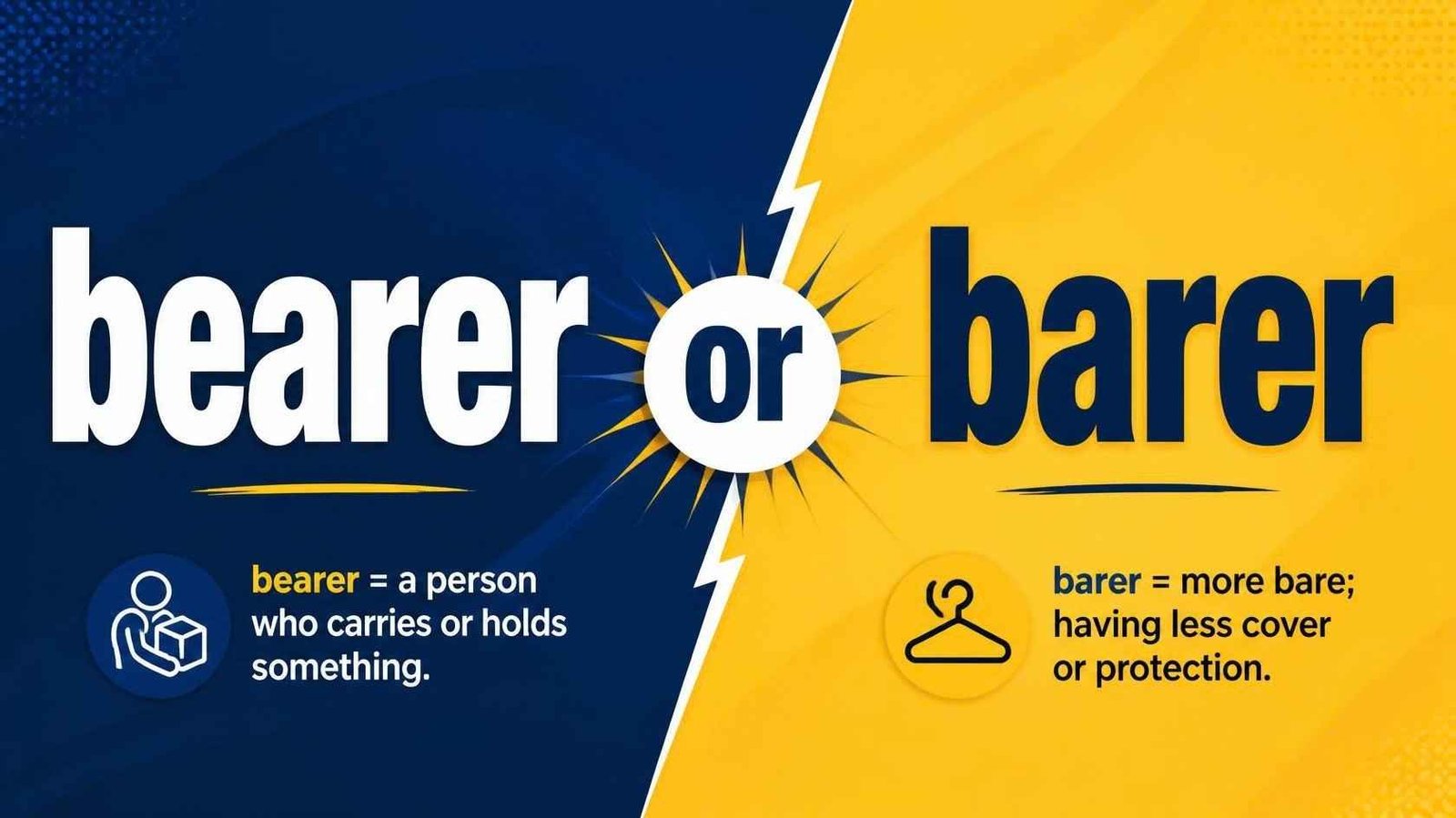
Here’s the quick answer to bearer or barer.
A bearer is a person who carries or holds something.
Barer means more bare or more exposed.
So a ring bearer carries the rings, and a barer room has lost its furniture.
Spell checkers won’t save you here.
Both words are real, so no red line shows up.
Only you can spot the mix-up.
Read on, and you’ll never second-guess these two again.
Quick Answer
Use bearer when you mean a person or thing that carries, holds, or delivers.
Use barer when you’re comparing how empty, plain, or uncovered something is.
So the ring bearer walks down the aisle, and a barer room just lost its furniture.
Both words are correct, but they never swap places.
Comparison Table
| Feature | Bearer | Barer |
| Part of speech | Noun | Comparative adjective |
| Core idea | One who carries or holds | More bare or more exposed |
| Root word | Bear (to carry) | Bare (uncovered) |
| Example | The bearer of the letter | A barer landscape |
Meaning Of Each Word
Think of these words as distant cousins who look alike at family dinners.
They share a sound, but they don’t share a job.
What Does Bearer Mean
A bearer is a person who carries something, holds something, or delivers something.
Think of a carrier, a holder, or a messenger.
It also covers someone who possesses a document, like a ticket bearer or a passport bearer.
In finance, the authorized bearer of a bearer instrument is simply whoever holds it.
What Does Barer Mean
Barer is the comparative form of bare.
It means more bare, more exposed, or less covered.
Say autumn hits and the trees lose their leaves.
Each week they look barer than before.
Bearer vs Barer Key Differences
The biggest gap is the grammatical function.
Bearer names a doer or holder, while barer describes how a thing looks.
The second gap is the context and meaning.
Bearer connects to carrying, holding, and delivering, while barer connects to exposure and missing covering.
Ask one question when you’re stuck.
Is someone carrying something, or is something losing its cover?
Which Word Is Correct
Neither word wins by default.
The correct spelling depends on what your sentence needs.
If your sentence has a person delivering, holding, or leading, pick bearer.
If your sentence compares emptiness or exposure, pick barer.
Pronunciation Guide
This is where the confusion starts.
The two words are homophones, so they sound the same.
Bearer
Bearer pronunciation in IPA is /ˈbɛərər/ in many accents.
American speakers often say /ˈbɛrɚ/, which sounds like “BAIR-er”.
Barer
Barer pronunciation is the same, /ˈbɛərər/.
That means bearer barer sound alike in everyday speech, with identical pronunciation.
Expert Writing Tip
Your ear won’t catch this mistake, so your eyes must.
Read the sentence once for meaning and once for spelling.
Spell checkers often miss it too.
Both words are real, so no red squiggle appears.
Examples In Sentences
Seeing the words at work beats any definition.
Here are sentence examples you can borrow.
Bearer Examples
Here are some bearer examples in real sentences:
- The bearer of this letter has my full permission to collect the parcel.
- She became the bearer of bad news at Monday’s meeting.
- The flag bearer led the team into the stadium.
- Only the authorized bearer may enter the vault.
Barer Examples
Here are some barer examples for comparison:
- The garden looks barer every November.
- His new apartment felt barer than expected after the move.
- With the shelves cleared, the room seemed barer still.
- The hillside grew barer as the snow melted.
Bearer vs Barer Common Mistakes
Even careful writers slip here.
The common English mistakes below cause most of the trouble.
Using Barer Instead Of Bearer
This is the classic spelling mistake.
Someone writes “the barer of the message” when they mean the person delivering it.
Remember that a message can’t be more bare.
A person carries it, so bearer fits.
Using Bearer Instead Of Barer
This one is rarer, but it happens.
“The room looked bearer than before” reads wrong.
You’re comparing emptiness here.
Swap in barer and the sentence works.
Confusing Ring Bearer And Ring Barer
Picture a couple printing wedding programs.
One typo turns a sweet role into “ring barer”.
The correct term is ring bearer, the child who carries the rings.
There is no “ring barer” in any dictionary.
Confusing Bearer Of Bad News Or Barer
“Barer of bad news” sounds plausible when you say it fast.
It’s wrong every time.
The idiom is bearer of bad news, meaning the person who delivers it.
Nobody is stripping the news bare.
Assuming Every Similar Sounding Word Has The Same Meaning
Words that sound the same don’t always share meaning.
Same pronunciation, different spelling is the whole trick of homophones.
Check the job of the word in your sentence.
That habit helps you avoid homophone mistakes across the board.
Etymology And Word Origin
Word history makes the split feel logical.
Each word grew from a different Old English root.
Origin Of Bearer
Bearer comes from the verb bear, from Old English beran, meaning to carry.
Add the suffix er, which marks a doer, and you get one who carries.
Origin Of Barer
Barer comes from the adjective bare, from Old English bær, meaning uncovered.
The same suffix er creates the comparative, so bare becomes barer.
Regional Usage
Good news for global writers.
Spelling here doesn’t change between regions.
American English
American English uses both words exactly as described.
The bearer is a carrier, and barer is the comparative of bare.
British English
British English treats them the same way.
Only the accent shifts a little, not the spelling or the meaning.
Australian English
Australian English keeps both spellings identical.
Expect a slightly different vowel sound when spoken.
Canadian English
Canadian English follows the same pattern.
You can use either word confidently in Canadian formal writing.
Grammar Rules
The grammar rules are short and clear.
One word is a noun, and the other is an adjective.
Bearer As A Noun
Bearer as a noun names a person or thing.
It often takes “of” and an object, like the bearer of news or the bearer of gifts.
Barer As A Comparative Adjective
Barer as a comparative adjective describes a noun.
It usually sits before a noun or after a linking verb, and often pairs with “than”.
Common Sentence Patterns
These common sentence patterns help you check yourself:
- Bearer of + noun (bearer of responsibility)
- The + bearer + verb (the bearer signs here)
- Noun + linking verb + barer (the walls look barer)
- Barer + noun (barer trees)
Real Life Usage Examples
Words live in context, so here are real life examples.
Each fits a different setting.
Daily Conversation
In everyday English you’d say, “Don’t shoot the messenger, I’m just the bearer of news.”
Or, “The fridge looks barer every Friday.”
Academic Writing
In academic writing you might say, “The bearer of the title holds legal rights.”
You could also say, “The barer landscape reflects seasonal decline.”
Professional Communication
In professional communication, a note may read, “The bearer of this pass may enter.”
A report may read, “The barer office layout cut costs.”
Literature And Media
Literature examples love the bearer as a symbol of duty.
A writer may cast a torch bearer as a hero or a standard bearer as a leader.
Barer appears in descriptive writing, especially for winter scenes.
A barer forest sets a mood in one word.
Related Words And Commonly Confused Terms
These terms show up beside our two words in search results.
Let’s clear them up.
Flag Bearer
A flag bearer carries a flag at a ceremony.
The flag bearer meaning also stretches to a spokesperson for a cause.
Ring Bearer
A ring bearer carries the rings at a wedding.
The ring bearer meaning stays ceremonial, and today it’s often a small child or even a dog.
Bearer Of Bad News Meaning
The bearer of bad news meaning is simple.
It’s the person who tells others something unwelcome.
Bearer Bond
A bearer bond belongs to whoever holds the paper.
No name is registered, which is why many countries restricted them.
Barer In English
People ask about barer in English because it feels unusual.
It’s just the standard comparative of bare, like fairer or rarer.
Barer Weapon
“Barer weapon” isn’t an established phrase.
You’ll likely see it as a mangled search for “bare weapon” or “bear weapon”.
Barrer Meaning
Barrer isn’t a standard English word.
It’s a misspelling of bearer or barer, so avoid it.
Barer Scrabble Word
Yes, barer is a valid Scrabble word.
Check your dictionary edition if you want to be sure before a tournament.
Similar Homophones
Plenty of similar homophones exist.
Think bear and bare, hair and hare, fair and fare, and pair and pear.
These commonly confused words trip up everyone.
Baring and bearing also cause mix-ups.
Bearer In Tech And Finance In 2026
Bearer is trending outside grammar too.
In software, a bearer token grants access to whoever presents it.
In money matters, a bearer certificate works the same way.
Whoever holds it can claim it, so protect it like cash.
Expert Language Insight
Editors often say homophone errors slip in when writers type fast.
Slow down on words tied to legal terminology, financial terminology, and ceremonial language.
One quick habit saves your credibility.
Read the sentence aloud, then ask what job each word does.
Frequently Asked Questions
Is bearer or barer correct?
Both are correct in different situations.
Use bearer for a carrier and barer for more bare.
What is the difference between bearer and barer?
Bearer is a noun linked to carrying.
Barer is an adjective linked to being uncovered.
Is it ring bearer or ring barer?
It’s ring bearer.
The word “barer” never fits this role.
Is it bearer of bad news or barer of bad news?
It’s bearer of bad news.
The person carries the message, so the noun applies.
Is barer a real English word?
Yes, barer is real.
It’s the comparative of bare, used to compare exposure or emptiness.
Why do people confuse these words?
They’re homophones with identical pronunciation.
Speech gives no clue, so the spelling has to.
Does bearer have legal meanings?
Yes, it does.
A bearer instrument gives rights to whoever holds it.
How can I remember the correct spelling?
Try this trick.
You bear a load, so it’s bearer, and you bare a wall, so it’s barer.
Conclusion
You’ve now got the full picture of bearer vs barer.
Bearer carries, barer exposes, and that split never changes.
Next time you write “ring bearer” or “bearer of bad news”, you’ll do it with confidence.
Got a homophone that drives you nuts? Drop it in the comments and share this guide with a friend who keeps typing “ring barer”.
Freshness note: revisit this guide each year to update examples, new usage trends, and any changes in finance or tech terms.
