

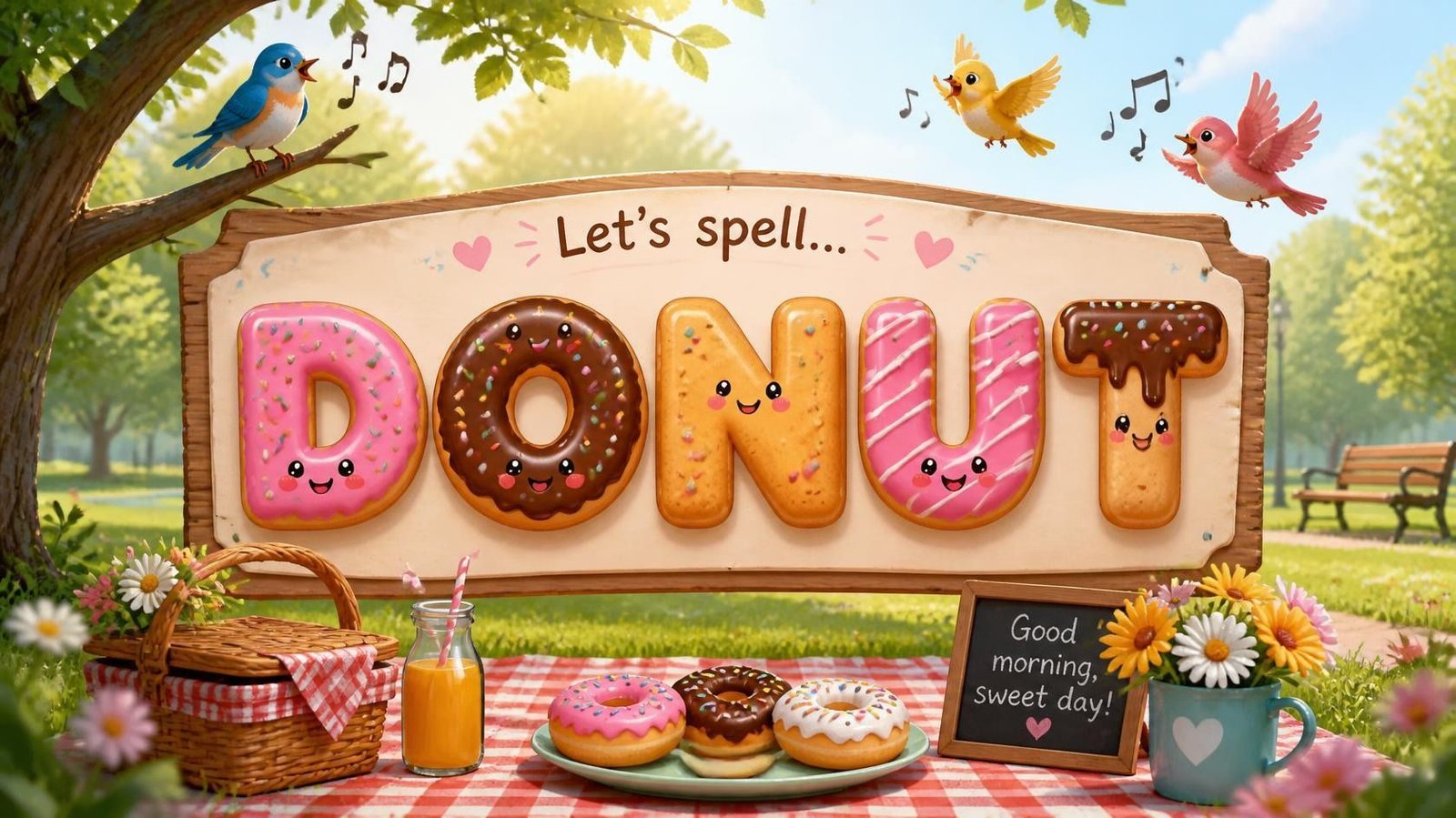
You’re typing a menu, a text, or a school paper.
Then you freeze and wonder if it’s donut or doughnut.
Here’s the quick answer.
Both spellings are correct, and donut is the shorter, more common form in American English.
Doughnut is the longer, traditional form, and you’ll see it more in British English.
Pick one and stay consistent.
This guide shows where each spelling came from, when to use which, and how to never mix them up again.
The short spelling is d, o, n, u, t.
That’s donut, and it’s the version most Americans type every day.
The long spelling is d, o, u, g, h, n, u, t.
That’s doughnut, the original spelling variant that dictionaries still list first in many cases.
Neither one is a mistake.
You only get into trouble when you spell it a third way, like “donught” or “donutt.”
Donut or Doughnut: What’s the Real Difference
There’s no difference in meaning.
Both words describe the same fried dough treat, usually sweet, round, and often glazed.
The only gap is style and region.
Donut feels casual and quick, while doughnut feels a bit more traditional.
Think of it like “color” and “colour.”
Same word, different habit.
| Spelling | Where It’s Common | Feel |
| Donut | United States, Canada | Casual, modern |
| Doughnut | United Kingdom, Australia | Traditional, formal |
Where Each Spelling Came From
The word is older than you’d guess.
One of the earliest printed uses of doughnut shows up in 1809, in Washington Irving’s book about New York.
Early doughnuts were small balls of fried dough.
People saw them as little “nuts” of dough, which is how the name stuck.
The shorter donut came later.
It started showing up in print around the early 1900s, and shop signs helped it spread.
Why did it catch on?
Signs cost money, and fewer letters meant less paint.
American English vs British English Spelling
In the US, donut wins in daily life.
You’ll see it on bakery boxes, coffee shop menus, and most social media posts.
In the UK, doughnut is still the default.
British papers, recipe sites, and bakeries mostly stick with the longer form.
Canada sits in the middle.
Many Canadians write donut, and one famous coffee chain there leans on the short form too.
Here’s a simple rule.
Match the spelling to where your readers live.
Which Spelling Should You Use in Your Writing
Start with your audience.
Writing for Americans? Use donut. Writing for a UK crowd? Use doughnut.
Then think about the setting.
For a casual blog, a menu, or a text message, donut feels natural.
For formal writing, check the style guide.
Some style guides, like AP, lean toward doughnut, so ask your editor or teacher if you’re unsure.
Whatever you pick, don’t switch halfway.
A paper that says donut in paragraph one and doughnut in paragraph four looks sloppy.
Common Misspellings and How to Fix Them
Most mistakes come from guessing at the sound.
The word is pronounced “DOH-nut,” so people try to spell it by ear.
Here are the wrong versions you’ll run into:
- Donught is a mix of both spellings, and it’s wrong.
- Donutt adds an extra t that doesn’t belong.
- Doughnutt has the same extra t problem.
- Donot looks like “do not” and changes the meaning.
- Dough nut with a space is two words, not one.
Notice the pattern.
Each error either borrows letters from the other spelling or adds something extra.
The fix is simple.
Pick donut or doughnut and copy it exactly, with no extras.
Easy Tricks to Remember the Spelling
For the long spelling, say the two parts out loud.
Dough plus nut gives you doughnut, and you can see both words inside it.
For the short spelling, think “no dough, no problem.”
The letters d, o, n, u, t just skip the “ugh” in the middle.
Here’s a trick I like.
If you spot “gh” in the word, you must also have “ou” before it, so it’s always “dough,” never “do.”
Another quick check works too.
If the word has five letters, it’s donut, and if it has eight, it’s doughnut.
How to Spell the Plural and Possessive Forms
The plural is easy.
Add an s, so you get donuts or doughnuts.
No apostrophe is needed for plurals.
“Two donut’s” is a common slip, and it’s wrong.
The possessive needs an apostrophe.
You’d write “the donut’s glaze” for one, and “the donuts’ flavors” for many.
Here are a few examples:
- I bought a dozen donuts for the team meeting.
- The doughnut’s filling leaked all over my desk.
- Both doughnuts’ icing melted in the sun.
How Big Brands Spell It
Brands are a good clue about real usage.
Dunkin’ Donuts, founded in Massachusetts in 1950, used the short spelling for decades.
The company later shortened its name to just Dunkin’ in 2019.
Even so, the donut spelling still shows up all over its menus and ads.
Krispy Kreme picked the long form.
The chain started in 1937 in North Carolina and sticks with doughnuts in its branding.
Tim Hortons leans short.
So you can see both spellings thrive side by side, even in the same country.
Does the Spelling Matter for Search and Google
Yes, a little.
People search for both donut recipes and doughnut recipes, and Google treats them as close relatives.
Search results often overlap.
Still, the words you use can change which sites show up first.
For a US audience, lead with donut.
For a UK audience, lead with doughnut, and mention the other form once so you cover both searches.
Here’s what I’d do for a food blog.
Use one main spelling across the page, and add the other in a heading or a short note.
Pronunciation and Everyday Usage
Both words sound the same.
You say “DOH-nut” no matter which way you spell it.
Spelling doesn’t change speech.
That’s why people trip up when writing, since the sound gives no hint about the letters.
In casual talk, nobody cares.
In an email to a client or a printed menu, a clean, consistent spelling shows care.
Quick Examples in Sentences
Seeing the word in action helps.
Here are a few lines using each form:
- She grabbed a donut and a coffee before work.
- The bakery sells a doughnut filled with raspberry jam.
- Friday’s donut box was empty by 9 a.m.
- He baked doughnuts from scratch on Sunday morning.
- National Doughnut Day falls on the first Friday of June.
That last one has a story.
The Salvation Army started the day in 1938 to honor volunteers who handed out doughnuts to soldiers in World War I.
Quick Answers to Common Questions
Is donut spelled with “ough”?
No, not in the short form.
Only doughnut has the “ough.”
Is donut a real word?
Yes, it is.
Dictionaries like Merriam-Webster and Oxford list both forms.
Which spelling is more common in the US?
Donut is more common in daily American use.
You’ll still see doughnut in some books and news outlets.
Can I use both in one article?
You can mention both once to explain the difference.
After that, stick with one.
Final Thoughts on How to Spell Donut
So here’s the takeaway.
Donut and doughnut are both right, and you just need to pick one that fits your readers.
Use donut for casual and American writing.
Use doughnut for traditional or British writing, and stay consistent from start to finish.
Which one do you use, and did you learn anything new here?
Drop a comment below and share this guide with a friend who always second guesses their spelling.
