

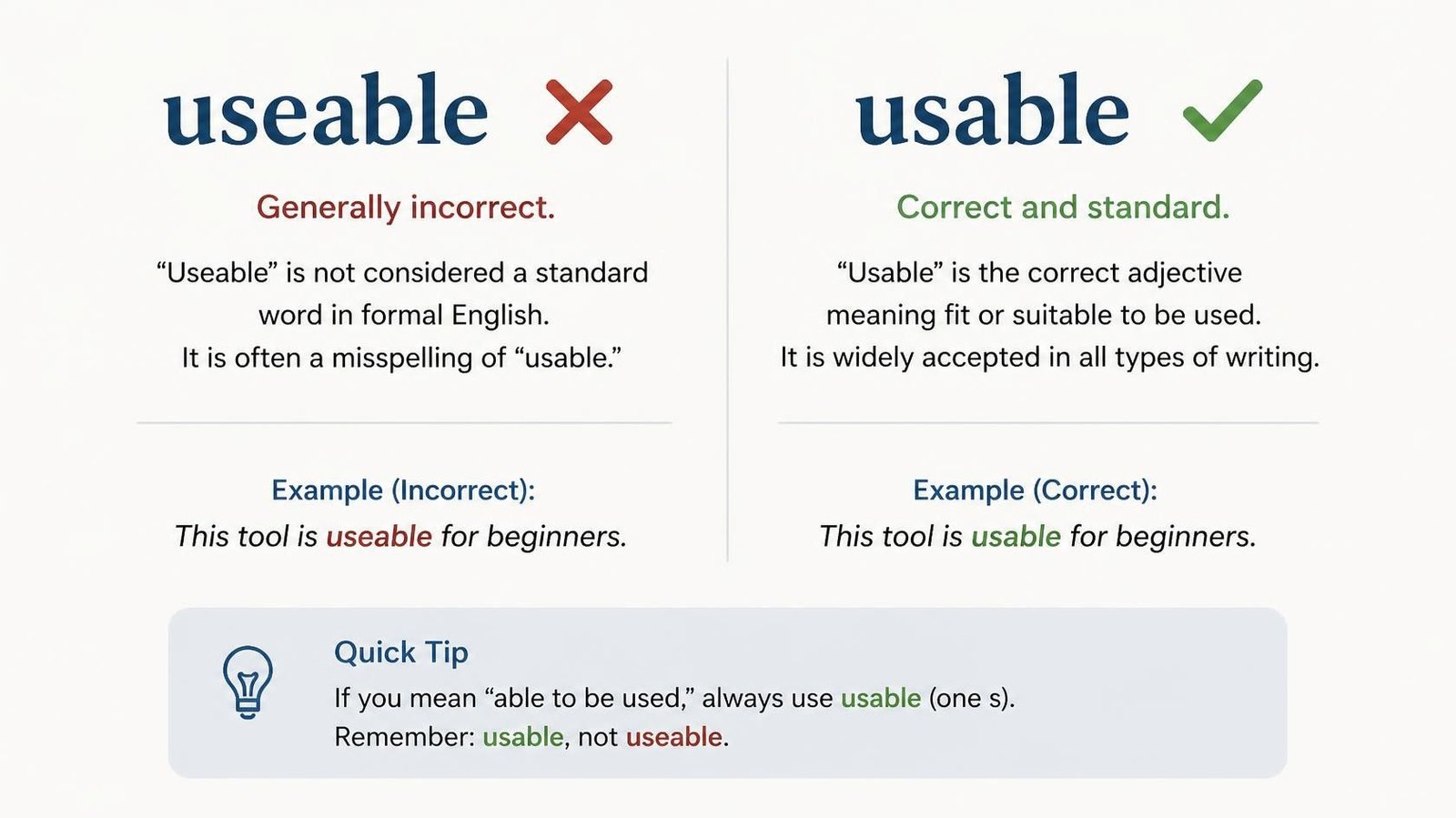
Have you ever wondered whether to write usable or useable? You are not alone. Many English learners, students, writers, and professionals find these two spellings confusing. Both words look correct, and both have the same pronunciation. However, one spelling is much more common in modern English.
The correct choice for most situations is usable. It is the standard spelling in American English and the preferred option in most professional, academic, and digital writing. Although useable is also an accepted variant, it is less common.
In this article, we will explain the difference between usable and useable, explore their meanings, provide practical examples, and show you how to choose the right spelling for your writing.
What Does Usable Mean?
The word usable is an adjective that describes something that can be used for a particular purpose. It refers to an object, tool, product, service, or resource that is suitable for use.
For example, a usable computer is a computer that works well enough to perform the tasks you need. Similarly, usable information is information that you can understand and apply.
The word comes from the verb use and the suffix -able. This suffix means that something is capable of being done or is suitable for a particular purpose.
Here are some examples:
- The website has a simple and usable design.
- We need a usable solution to this problem.
- The old laptop is still usable.
- Please provide a usable email address.
- The instructions make the software more usable.
In each sentence, usable describes something that can be used effectively or practically.
What Does Useable Mean?
Useable is an alternative spelling of usable. It has the same meaning and pronunciation. Both words describe something that can be used or is suitable for use.
However, useable appears less frequently in modern English. Many dictionaries recognize it as a variant, but most writing guides recommend usable because it is shorter, more familiar, and more widely accepted.
For example:
- The damaged chair is still useable.
- We found a useable version of the document.
- The tool is useable for basic repairs.
These sentences communicate the same meaning as their versions with usable. The difference is spelling rather than definition.
If you are writing an essay, business email, website article, report, or social media post, choosing usable is generally the safest option.
Usable vs. Useable: What Is the Difference?
The main difference between usable and useable is their frequency of use, not their meaning.
Both spellings are understood by English readers. However, usable is the more common and widely preferred form, especially in American English.
| Feature | Usable | Useable |
| Meaning | Suitable for use | Suitable for use |
| Pronunciation | Usually the same | Usually the same |
| Grammatical role | Adjective | Adjective |
| American English | Preferred spelling | Less common variant |
| British English | Common and accepted | Also found |
| Professional writing | Recommended | Usually unnecessary |
| SEO content | Recommended | Less common search variant |
The table shows that both words are valid, but usable is the better default choice.
Which Spelling Is More Common?
Usable is considerably more common in everyday writing, published materials, and professional communication. It is also the form most readers will expect to see.
Useable is not necessarily a spelling mistake. Instead, it is a less common variant that may appear in some publications or individual writing styles.
When consistency and readability matter, choose usable.
Are Usable and Useable Pronounced the Same?
Yes. Both words are generally pronounced the same way: YOO-zuh-buhl.
Their pronunciation does not change when the extra letter e appears in useable. The difference is visible in writing rather than audible in speech.
This is one reason people sometimes struggle to choose between the two spellings.
Why Is Usable the Preferred Spelling?
There are several reasons why usable is the better choice for most writers.
1. It Is More Common
Usable is the spelling most readers encounter in modern English. Using familiar words and spellings makes your content easier to read.
2. It Is Concise
The spelling usable contains one fewer letter than useable. Although the difference is small, concise spelling is often preferable when both forms communicate the same meaning.
3. It Fits Professional Writing
Business documents, academic assignments, product descriptions, and website content benefit from standard, consistent spelling.
For example, write:
“The company developed a usable mobile application.”
This sentence sounds natural and uses the more widely preferred spelling.
4. It Works Well for SEO Content
If you write blog posts or web pages, usable is generally the better primary keyword because it is the more common form.
However, search optimization should never come at the expense of clear writing. Use the word naturally instead of repeating it unnecessarily.
How to Use Usable in a Sentence
Understanding the meaning is easier when you see usable in different contexts. The word can describe physical objects, digital products, information, spaces, and practical solutions.
Examples in Everyday English
- This pen is still usable.
- We need a usable kitchen table.
- The damaged road is barely usable.
- Is this coupon still usable?
- The room has enough usable space for a desk.
These examples show that usable can describe anything that remains suitable for a particular purpose.
Examples in Business Writing
Usable is especially helpful when discussing products, services, and workplace processes.
- The team created a usable project plan.
- We need usable data before making a decision.
- The new system provides a more usable interface.
- Please send a usable copy of the report.
- The company aims to make its services more usable.
In these examples, usable emphasizes practical value and the ability to accomplish a task.
Examples in Technology
Technology writers often use usable when discussing software, websites, mobile applications, and digital tools.
- The application has a clean and usable interface.
- The website should be usable on mobile devices.
- The backup file is not usable because it is corrupted.
- Designers tested the website to make it more usable.
- The software offers several usable features.
In user experience design, the related word usability refers to how easily people can use a product to achieve their goals.
Common Mistakes to Avoid
Although usable and useable have the same meaning, writers can make other mistakes when using these words.
Mistake 1: Treating Useable as Always Incorrect
Useable is an accepted spelling variant. Calling it universally incorrect is too strict.
However, usable remains the preferred spelling for most writing situations.
Mistake 2: Confusing Usable With Useful
These words are related but do not mean exactly the same thing.
- Usable means capable of being used or suitable for use.
- Useful means helpful or beneficial.
For example, a tool may be usable because it works, but it may not be useful for the task you want to complete.
Mistake 3: Using Usable When You Mean Usability
Usable is an adjective, while usability is a noun.
Correct: “The website is usable.”
Correct: “The website’s usability has improved.”
Incorrect: “The website’s usable has improved.”
Choosing the right grammatical form helps your writing remain clear and professional.
Mistake 4: Changing Spellings Without a Reason
Consistency matters in professional writing. If you choose usable at the beginning of an article, continue using that spelling throughout the document.
Avoid switching between usable and useable unless you are specifically discussing spelling differences.
Usable vs. Useful vs. Usable: Understanding Related Words
English contains several words that look or sound similar but have different meanings.
| Word | Part of speech | Meaning | Example |
| Usable | Adjective | Capable of being used | The device is usable. |
| Useable | Adjective | Alternative spelling of usable | The device is useable. |
| Useful | Adjective | Helpful or beneficial | This guide is useful. |
| Usability | Noun | Ease or quality of use | The app’s usability improved. |
| Usefulness | Noun | The quality of being helpful | We measured its usefulness. |
The distinction between usable and useful is particularly important. Something can be usable without being especially useful, and something can be useful in theory but difficult to use in practice.
For example, a complicated software tool may offer useful features but have poor usability.
Should You Use Usable or Useable in American English?
For American English, usable is the recommended choice.
It is widely recognized, concise, and suitable for everyday communication, professional documents, academic work, and online content.
Consider these examples:
- The software is usable on older computers.
- We need a usable solution before Friday.
- The company released a more usable version of its website.
Each sentence follows standard modern usage.
Although American readers can understand useable, there is little reason to choose the longer variant unless you are following a specific publication’s style guide.
Should You Use Usable or Useable in British English?
British English also commonly uses usable. The spelling useable appears as a variant, so it is not automatically incorrect in British writing.
If you are writing for a British audience, usable is still a practical default. Follow your organization’s preferred dictionary or style guide if it specifies a particular spelling.
The most important point is to remain consistent and avoid treating a regional or less common variant as an error in every context.
How to Remember the Correct Spelling
A simple way to remember the preferred spelling is to focus on the base word use and the suffix -able.
In modern English, the final e in a word is sometimes dropped before adding a suffix that begins with a vowel. This is why the preferred spelling is usable rather than useable.
Compare these examples:
- Use + able = usable
- Read + able = readable
- Adapt + able = adaptable
- Enjoy + able = enjoyable
English spelling has exceptions, so this pattern is not an absolute rule. Nevertheless, it provides a helpful reminder for choosing usable in ordinary writing.
You can also remember this simple tip: When in doubt, use usable.
Frequently Asked Questions
1. Is usable or useable correct?
Both spellings are accepted, but usable is the more common and widely preferred spelling in modern English.
2. Is useable a real word?
Yes. Useable is a recognized variant of usable. It has the same meaning but is used less frequently.
3. Which spelling is correct in American English?
Usable is the standard choice in American English. It is recommended for schoolwork, business documents, and website content.
4. Are usable and useable pronounced the same?
Yes. Both are generally pronounced YOO-zuh-buhl and have the same meaning.
5. Why is usable spelled without an e?
The final e in use is dropped when forming the more common spelling usable. This follows a familiar English spelling pattern.
6. Should I use usable or useable for SEO?
Use usable as your primary spelling because it is more common. Include the alternative spelling only when it fits the topic naturally.
7. What is the difference between usable and useful?
Usable means something can be used or is suitable for use. Useful means something is helpful or beneficial.
Final Thoughts
The choice between usable and useable is simple once you understand their relationship. Both spellings communicate the same meaning, and useable is recognized as a variant. However, usable is more common and is the preferred spelling in most modern English writing. It works well in academic assignments, business communication, website articles, product descriptions, and everyday messages.
If you want your writing to look clear, natural, and professional, choose usable by default. Remember that useful has a different meaning, while usability is the noun that describes how easy or effective something is to use. Understanding these small differences can improve your grammar, strengthen your vocabulary, and help you communicate more confidently.
