

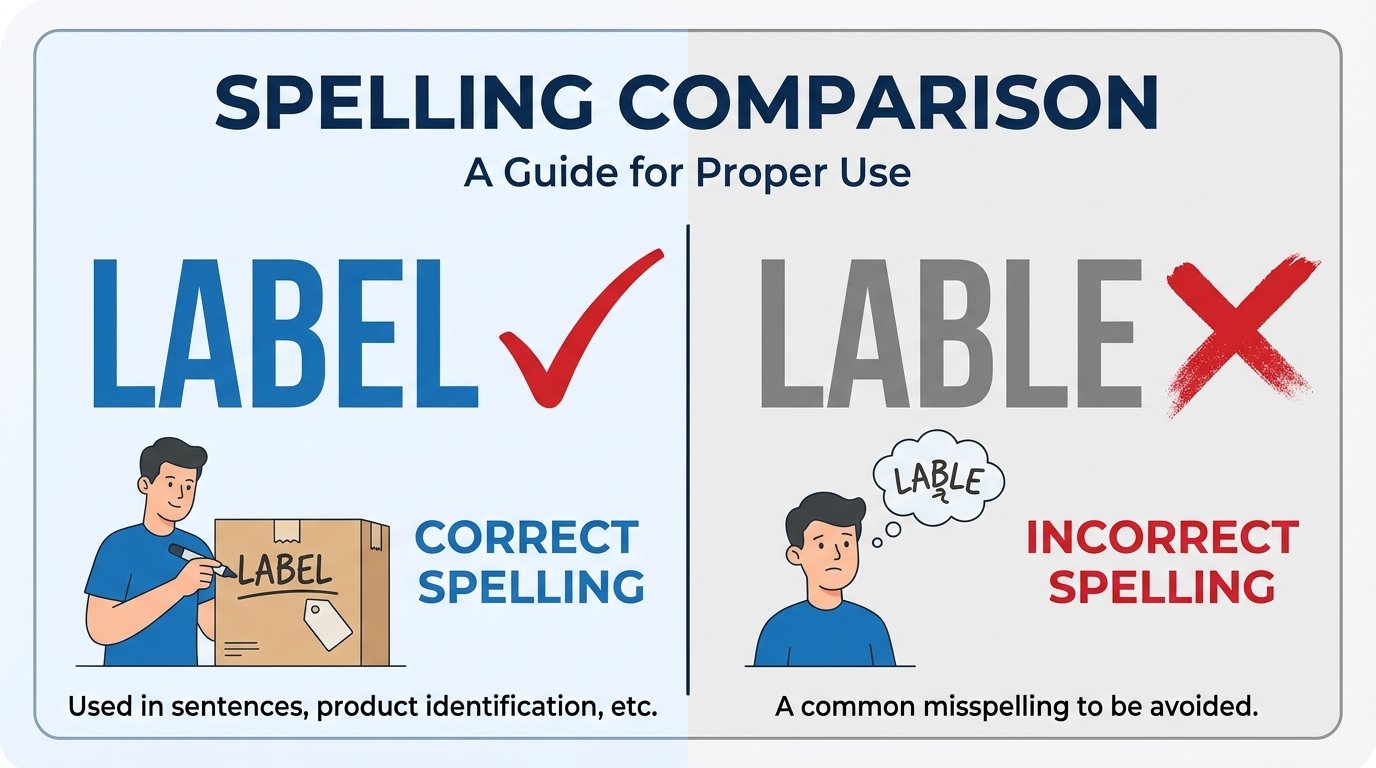
Did you just type “lable” and see a red line under it?
Or maybe you’re writing a product page and want to be sure.
You’re not alone, and this is a very common worry.
The short answer is simple.
“Label” is the correct spelling.
“Lable” is a typo, and it’s not a real English word.
In this guide, you’ll learn why “label” is right.
You’ll also see where the word comes from, how British and American writers use it, and how to avoid the mistake for good.
Lable or Label – Quick Answer
“Label” is the only correct spelling.
It’s spelled L-A-B-E-L.
The “e” comes before the “l” at the end.
“Lable” swaps those two letters.
That’s why it looks almost right at a quick glance.
But no dictionary lists it.
Here’s a fast way to see it:
- Correct: label
- Wrong: lable
Use “label” on packages, forms, emails, and websites.
That’s all you need to remember.
The Origin of Label
The word “label” came into English in the 1300s.
It came from Old French, where it meant a ribbon or a strip.
It likely has roots in an older Germanic word for a flap or a rag.
Back then, a label was a narrow band of cloth.
People also used the word for a strip attached to a document to hold a seal.
Over time, it became a small piece of paper or material attached to something to tell you what it is.
Today, the meaning is much wider.
A label can be a sticker on a jar, a tag on a shirt, or a name given to a person or idea.
It can even mean a music company, like a record label.
The spelling stayed steady for centuries.
That’s one more reason “lable” has no history behind it.
British English vs American English Spelling
Good news here.
The base word “label” is spelled the same in both British and American English.
There’s no UK or US version of “lable” to worry about.
The difference shows up when you add endings.
British English usually doubles the “l.”
American English usually keeps one “l.”
Here’s how it looks:
- American: labeled, labeling
- British: labelled, labelling
Both versions are correct in their own region.
Just pick one style and stick with it through your whole piece.
Which Spelling Should You Use?
Use “label” every time.
It works for the noun and the verb.
It’s right in every country and every type of writing.
If your readers are in the US, write “labeled” and “labeling.”
If they’re in the UK, Australia, India, or Pakistan, “labelled” and “labelling” are the common choice.
Canada often mixes both, but “labelled” is popular there too.
Not sure who your readers are?
Check your style guide or your spell checker’s language setting.
Then stay consistent.
Common Mistakes with Label
Most errors come from fast typing.
Your fingers hit the “l” before the “e.”
That’s how “lable” slips in.
Here are the mistakes people make most:
- Lable instead of label
- Labal instead of label
- Labell instead of label
- Labelled and labeled mixed in the same article
The last one is sneaky.
It isn’t a spelling error, but it looks sloppy.
Choose one style and keep it.
A quick tip helps here.
Read the word out loud in two parts: “la” and “bel.”
That sound matches the correct spelling.
Why Do People Write “Lable”?
Our brains often read words as a whole shape.
Because of this, we don’t always spot swapped letters.
“Label” and “lable” have the same letters, just in a different order.
Many words end in “ble,” like table, cable, and stable.
So the pattern feels familiar.
Your hand follows it without asking you.
But “label” ends in “el,” like angel, level, and model.
Thinking about those words can help.
They share the same ending sound and spelling.
Label in Everyday Examples
You see labels all day long.
Here are some simple examples that use the correct spelling.
As a noun:
- Please read the label on the medicine bottle.
- The shirt label says “wash cold.”
- She signed with a big record label.
As a verb:
- I labeled every box before the move.
- The teacher labels each drawer with a name.
- Please label the chart clearly.
As a figure of speech:
- Try not to put a label on people.
- He hates being labeled as shy.
Notice that the spelling stays the same in each case.
Only the ending changes with the verb tense.
That keeps it easy.
Label – Google Trends & Usage Data
Search data tells a clear story.
“Label” is searched far more than “lable.”
Most searches for “lable” come from people checking if it’s a real word.
This pattern is common with typos.
People type the wrong version, then search to confirm the right one.
That’s smart, and it’s why guides like this one exist.
You can check it yourself.
Open Google Trends and compare “label” with “lable.”
The gap is big, and “label” wins by a wide margin.
You’ll also see “label” spike around shopping seasons.
People search for shipping labels, name labels, and food labels more at those times.
Usage data shows how useful the word is in daily life.
Common Phrases Using “Label”
“Label” shows up in many everyday phrases.
Knowing them helps you use the word with confidence.
Here are the ones you’ll hear most.
- Record label: a company that produces and sells music
- Price label: a tag showing the cost
- Warning label: a notice about danger or risk
- Nutrition label: the facts panel on food packaging
- Label maker: a device that prints small labels
- Private label: a product sold under a store’s own brand
- Label someone: to describe a person with a single word
- Mislabeled: marked with the wrong information
- Designer label: a fashion brand name
Each of these uses the same spelling.
Even the longer forms keep the “el” ending.
Easy Tricks to Remember the Spelling
Want to lock it in?
Try one of these quick tricks.
- Think “el”: label ends like angel and model.
- Say it slowly: “la” plus “bel.”
- Picture the tag: the “e” sits right before the last “l.”
- Use autocorrect: add “lable” to your phone’s replacement list so it fixes itself.
Pick the one that clicks for you.
After a few times, it’ll feel natural.
Comparison Table: Label vs Lable
| Feature | Label | Lable |
| Correct spelling | Yes | No |
| Found in dictionaries | Yes | No |
| Part of speech | Noun and verb | None |
| Used in the US | Yes | No |
| Used in the UK | Yes | No |
| Past tense | Labeled (US), labelled (UK) | None |
| Example | Check the label. | Not valid |
The table makes it plain.
Only one of these is a real word.
FAQs
Is “lable” ever correct?
No, it isn’t.
It’s a common typo of “label.”
Is “label” a noun or a verb?
It’s both.
You can read a label, and you can label a box.
Is it “labeled” or “labelled”?
Both are correct.
Use “labeled” in American English and “labelled” in British English.
Why does spell check flag “lable”?
Because it’s not in any dictionary.
Your software sees it as an error.
Does “label” have different spellings in the UK and US?
Not for the base word.
Only the verb endings change.
What does “label” mean?
It’s a tag, sticker, or word that identifies something.
It can also mean to describe someone or something in a certain way.
