

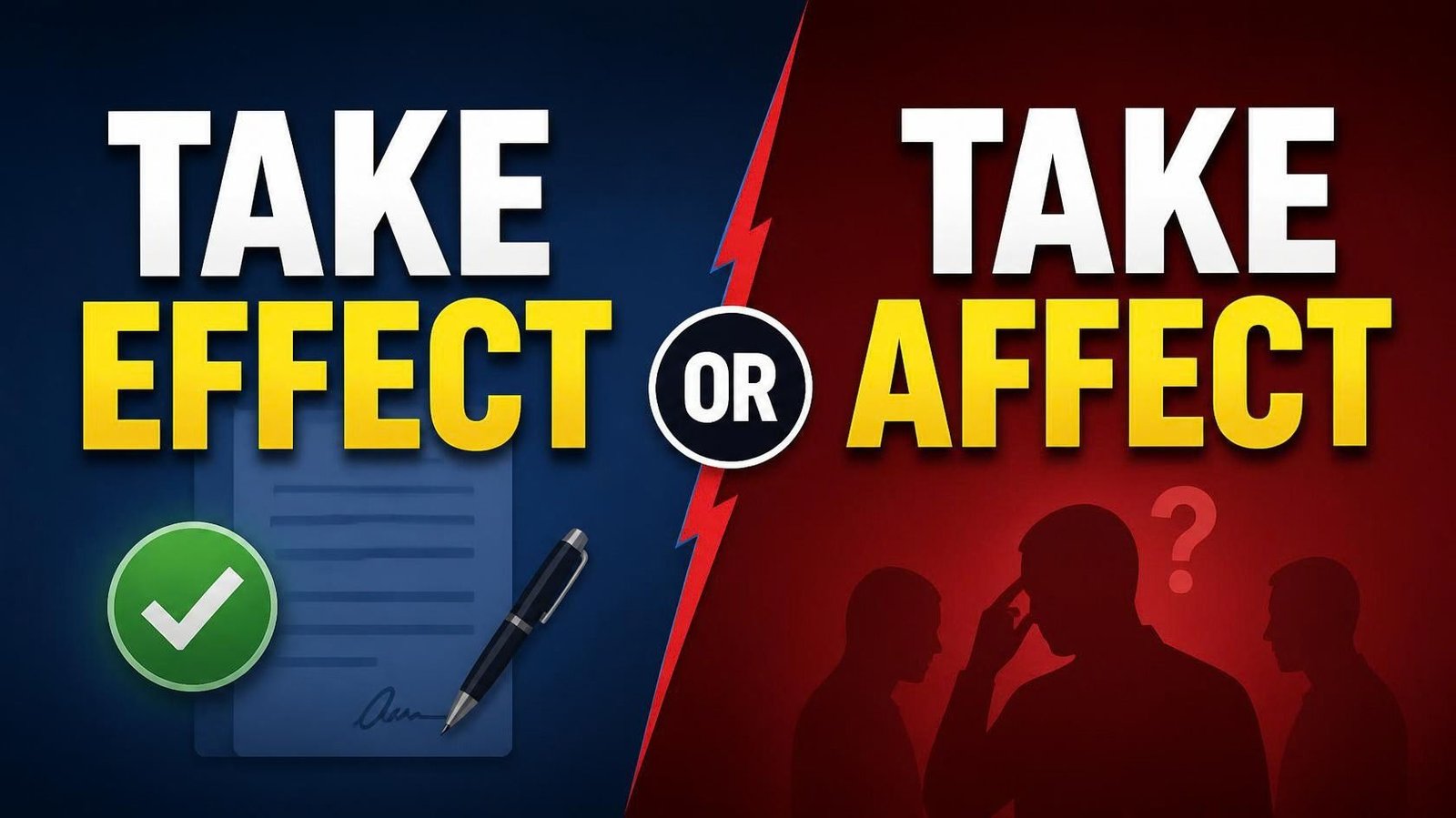
You’re writing an email about a new policy.
You type “will take” and then you stop.
Is the next word “effect” or “affect”?
Many people freeze right here.
It’s a tiny word, but it feels risky.
Nobody wants a typo in a work message.
I’ve seen smart writers hesitate at this exact spot.
Spellcheck doesn’t help, because both words are real.
That’s why this one sneaks past so many of us.
So, which one is right, take effect or take affect?
The answer is take effect.
It means something starts working or becomes active.
Take affect is a common mistake.
A new law will take effect next month, for example.
In this guide, you’ll learn why.
You’ll also get easy tricks and real examples.
Let’s clear it up together.
No grammar degree needed.
You’ll pick the right word without thinking.
Take Affect or Take Effect: Quick Answer
The correct phrase is take effect. It means something begins working or becomes active.
Think of a new law will take effect next month, or a medicine will take effect in an hour.
“Take affect” is the incorrect phrase. It’s a grammar mistake that sneaks in because the two words look and sound alike.
Spellcheck won’t catch it either, since both words are real.
Here’s the simple rule you can lean on.
In this phrase, “effect” is a noun. It names a result or outcome that kicks in.
You don’t “take” a verb. You “take” a thing, and the thing here is the effect.
The Origin of Take Affect or Take Effect
Both words trace back to Latin through Old French. That shared family tree explains why they feel so similar.
Effect grew from a Latin root about accomplishing or bringing something to completion.
Affect comes from a root about acting on something or influencing it.
Over time, “effect” picked up a legal and practical flavor. People said a rule had “effect” once it was in force.
So “take effect” became the standard way to say a rule, policy, or agreement begins to apply.
The mix up grew because the words sound almost identical in everyday speech. Most people say them the same way.
That’s why this word confusion shows up in writing far more than in conversation.
Take Effect Meaning: What the Phrase Actually Says
The take effect meaning is simple. Something starts working, becomes operational, or begins to produce a result.
You can also say it will go into effect, come into force, or become effective.
Notice how the phrase fits many situations.
A tax law will take effect on a set date. An update will take effect after you restart your phone.
You can also add timing words to it.
- Take effect immediately means it starts right now.
- Take effect tomorrow means it starts the next day.
- Take effect next month means it begins when the calendar flips.
Affect vs Effect: The Difference in Plain English
Here’s the difference between affect and effect in one breath.
Affect is usually a verb that means to influence something. Effect is usually a noun that means a result or outcome.
Try this quick test. Can you swap in “influence” and still make sense?
If yes, you probably want affect. If you can swap in “result,” you want effect.
There are rare twists that trip people up.
- Affect can be a noun in psychology, where it describes a person’s visible emotional state.
- Effect can be a verb meaning to bring about, as in “effect change.”
Those uses are real, but they’re uncommon. For everyday English writing, stick with the basic split.
That’s the core of affect vs effect and effect vs affect alike.
British English vs American English Spelling
Good news here. There’s no split between British English and American English on this one.
Both UK English and US English spell it take effect.
Many English spelling differences involve words like “colour” and “color” or “organise” and “organize.”
This pair doesn’t work that way. It’s the same spelling and the same meaning on both sides of the Atlantic.
So if someone says “take affect” is a British thing, they’re mistaken.
It’s simply an error, no matter where you live.
Which Spelling Should You Use?
Always use take effect. It’s standard English and it’s the correct spelling.
You can use it in formal writing, informal writing, and everything between.
Save affect for moments when you mean to influence something.
“The rain will affect our plans” works. “The rule will take affect” doesn’t.
Here’s a handy side by side check.
- Use take effect when something starts or becomes active.
- Use affect when something influences something else.
- Use effect when you mean a result or outcome.
Common Mistakes with Take Affect or Take Effect
The biggest slip is writing “take affect” because it looks natural. Your brain sees “affect” a lot as a verb, so it grabs it by habit.
That’s the classic common spelling mistake behind this phrase.
Another trap is overcorrecting. Some writers learn “effect is the noun” and start using it everywhere.
Then you get “this will effect our budget,” which should be “affect.”
Want to avoid take affect for good? Try these quick habits.
- Ask yourself if the sentence is about starting. If yes, write “take effect.”
- Replace the phrase with “begin working.” If it fits, you’re set.
- Read the sentence out loud and check for a missing “the.” “Take the effect” makes the noun obvious.
These are small fixes, but they work. They turn a grammar correction into a quick reflex.
Most common grammar errors fade once you build a checking habit.
Take Affect or Take Effect in Everyday Examples
Examples make the rule stick. Let’s walk through the places you’ll actually write this phrase.
Each one shows how to use take effect without a second thought.
Emails
Picture this. You’re telling your team about a new schedule.
You write, “The new work hours will take effect on Monday.”
Another one for your inbox. “Our agreement shall take effect once both sides sign.”
Short, clear, and correct.
News
Headlines love this phrase. You’ll see “New speed limits take effect this week.”
You’ll also see “The tax law will take effect in January.”
Reporters use it because it’s tight and precise. It tells readers the exact moment a change starts to apply.
Social Media
Online, people type fast and skip the proofreading. That’s where “take affect” slips through.
A better post reads, “The new update will take effect tonight, so save your work.”
Or something lighter. “That coffee finally took effect, and I’m awake.”
Casual tone, correct phrase.
Formal Writing
In contracts, reports, and policies, accuracy matters most. Here you’ll often see “shall take effect” or “comes into force.”
For example, “This policy will take effect on the first day of the fiscal year.”
In professional writing, a small slip can hurt your credibility.
Getting this one right tells readers you pay attention.
Take Affect or Take Effect: Google Trends and Usage Data
I can’t pull live search numbers here, so I won’t invent any. You can check them yourself in minutes.
Open Google Trends and compare “take effect” with “take affect” side by side.
Here’s what you’ll likely notice. “Take effect” dominates because it’s the real phrase.
“Take affect” shows up as a small, steady trickle that mostly comes from typos and uncertainty.
Look for seasonal bumps too. Searches around phrases like law takes effect or rules take effect often rise near new year changes, tax season, and big policy announcements.
That tells you people look this up exactly when a deadline is near.
Comparison Table: Take Affect vs Take Effect
Here’s a quick view you can screenshot or bookmark.
| Feature | Take Effect | Take Affect |
| Correct or incorrect | Correct | Incorrect |
| Meaning | Begin working or become active | No standard meaning |
| Word type used | Noun (effect) | Verb (affect) |
| Example | The rules take effect Friday | The rules take affect Friday (wrong) |
| Used in formal writing | Yes | No |
| Same in UK and US English | Yes | Not accepted in either |
If you remember only one line, make it this one.
You “take” an effect, so the phrase is always take effect.
Quick Tricks to Remember the Difference
Memory tricks beat memorizing grammar rules. Here are a few that actually stick.
Pick the one that fits your brain.
- A for Action, E for End result. Affect is the action. Effect is the end result.
- Arrow and End. Affect is the arrow, and effect is where the arrow ends up.
- The “the” test. If “the” fits before the word, you want effect.
Another trick is to stick with the whole phrase. Treat “take effect” like one chunk, just like “take place” or “take part.”
When you learn it as a chunk, you stop breaking it apart.
FAQs
1. Is “take affect” ever correct?
Almost never. In rare psychology writing, “affect” can be a noun about emotion, but “take affect” isn’t a standard phrase.
For everyday use, treat it as a grammar mistake.
2. What does “take effect” mean?
It means to begin working, become active, or start to apply.
A new law will take effect when it becomes enforceable.
3. Why do people confuse affect and effect?
They look alike, sound alike, and share Latin roots. Both are real words, so spellcheck stays quiet.
That makes them commonly confused words for nearly everyone.
Conclusion
So, take affect or take effect? It’s take effect, every time.
It means something starts, becomes active, or begins to produce a result.
Remember the simple split. Affect is usually the verb that influences, and effect is usually the noun that names the result.
Use the quick tests, and this commonly confused pair won’t trip you again.
Now it’s your turn. Which word pair still gives you trouble?
Drop it in the comments, and share this guide with someone who needs it before their next email.
