

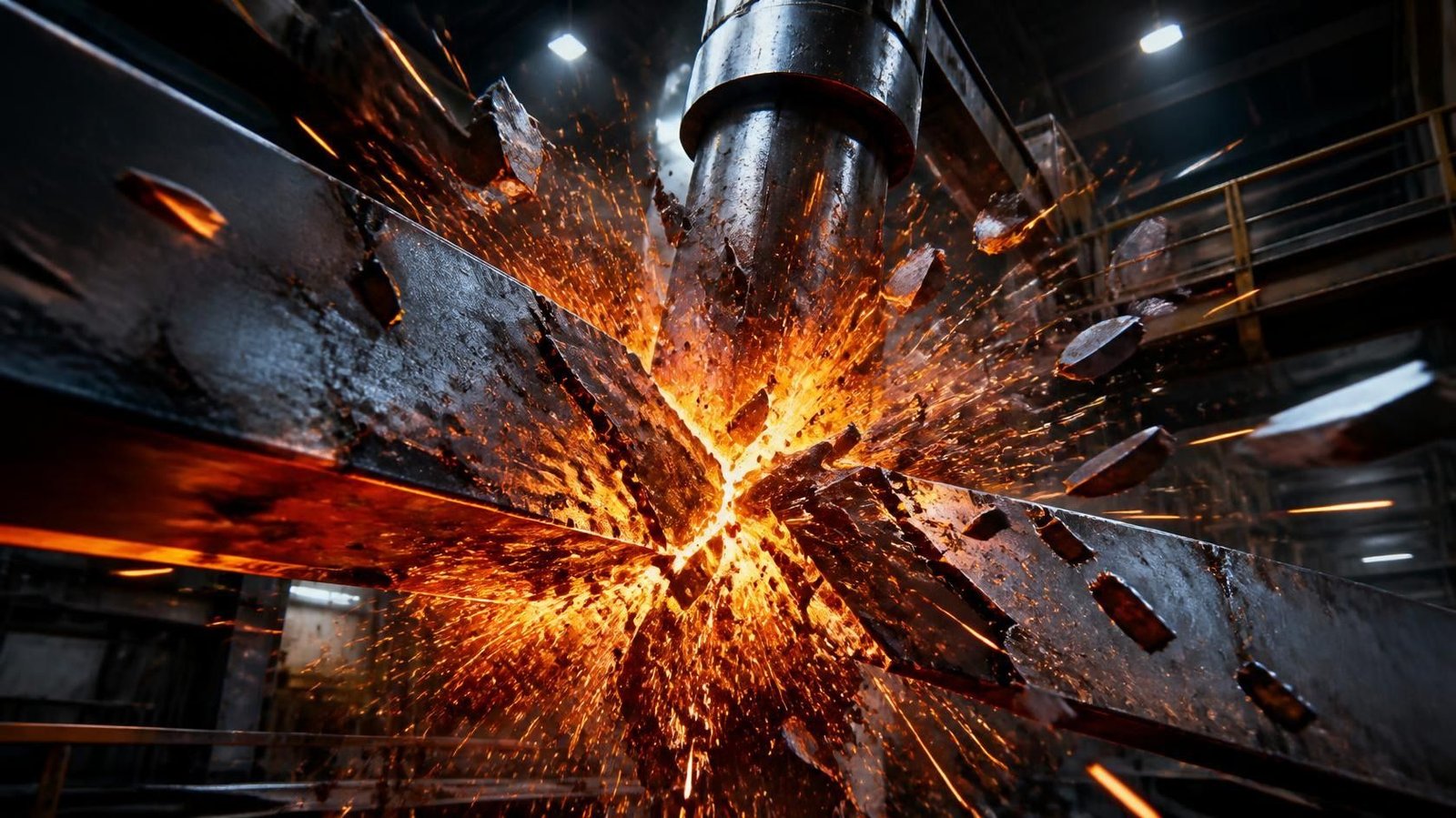
You’re typing a work order and you freeze.
Is it break metal or brake metal?
It’s brake metal, and the answer is simple once you see why.
A brake is the machine that bends sheet metal, so the spelling follows the tool.
Break means to smash or snap something, which is exactly what you don’t want your metal to do.
Break Metal or Brake Metal: Quick Answer
The correct spelling of brake metal is B-R-A-K-E.
In sheet metalworking, a brake is a brake machine that folds and bends flat stock into angles.
So when a shop says it will brake a piece of metal, it means the piece gets bent on that machine.
Break metal is a different idea.
Break means to damage or shatter, so “break metal” describes cracking or snapping it.
You’d use it when a part fails under stress, not when a fabricator shapes it on purpose.
Here’s the fast version:
- Brake metal: to bend metal using a press brake or sheet metal brake
- Break metal: to crack, snap, or destroy metal by accident or force
- Quick test: if the metal gets a clean fold, it’s brake
What Does Brake Metal Mean in Metalworking?
When people ask what does brake metal mean, they usually picture a car.
That’s a fair guess, but the brake machine used to bend metal has nothing to do with stopping a vehicle.
It’s a shop tool with a clamp and a bending beam.
You slide flat stock in, clamp it, and swing the beam up.
The sheet folds along a straight line, and you get a clean angle.
That’s metal bending in its simplest form, and it’s the base of most sheet metal fabrication.
The brake metal definition I’d give a new apprentice is this:
it’s the act of folding metal along a set line using a brake.
You can do it on a small bench unit or a big hydraulic press brake on a factory floor.
The Origin of Break Metal or Brake Metal
These two words share a family tree.
Most dictionaries trace the tool name back to old Dutch and Low German words for a device that crushed or broke things, like flax fibers.
So the tool name comes from the idea of breaking, even though the spelling split later.
Over time, English settled on brake for the devices and break for the action.
That’s why a car’s stopping system and a metal folding tool both use the “a” spelling.
They’re both mechanical tools, and both control or force something.
Here’s the part that trips people up.
The words sound identical, so your ear can’t help you.
Linguists call them homophones in English, which means words that sound alike but carry different meanings and spellings.
British English vs American English Spelling
Good news: there’s no split here.
Brake is spelled the same in the UK, the US, Canada, and Australia.
This isn’t like “colour” versus “color,” so you don’t need to pick a side.
The difference is in what shops call the machine.
In Britain, many fabricators say folding machine or folder for a metal bending machine.
In the US, brake and press brake are the everyday words.
So is brake metal the same in British and American English?
The spelling is, yes.
The shop talk may change, but the “a” never does.
That matters for spelling consistency across English varieties.
If your company ships manuals worldwide, keep “brake” for the tool and mention “folding machine” once for UK readers.
It helps both groups find what they need.
Which Spelling Should You Use?
Use brake whenever you mean the tool or the act of bending with it.
Use break when you mean something cracks, snaps, or stops working.
That one rule covers almost every case.
Here’s a quick table you can screenshot:
| Situation | Correct word | Why |
| Bending a sheet on a machine | brake | the tool does the bending |
| A weld cracks under load | break | the metal fails |
| Taking a lunch pause | break | it’s a rest |
| Slowing down a truck | brake | it controls speed |
If you’re stuck, ask what’s happening to the metal.
Is it being shaped, or is it being damaged?
Shaped means brake, and damaged means break.
Common Mistakes with Break Metal or Brake Metal
The biggest slip is writing “break metal” in a work order when the job is bending.
A shop floor reads that as “snap the part,” and that can cause real confusion.
It’s one of the most common spelling mistakes in metalworking terminology.
Another mistake is mixing the noun and the verb.
Some people write “metal break” for the machine, which sounds like a fracture.
The tool is a sheet metal brake, and the part it makes is a bent sheet metal piece.
Here are mistakes I see most often:
- Writing “press break” instead of press brake
- Using “break” for metal forming in product listings
- Spelling it “brake” when describing a metal failure
- Switching spellings halfway through one document
Small slips like these hurt technical writing accuracy.
A buyer might think a listing is careless and skip it.
That’s a quiet way to lose a sale.
Why Is Brake Metal Spelled with an A?
It follows the tool, not the action.
The name for the machine took the “a” spelling, and the verb “to brake” grew from it.
You can think of it as the same word family as the car part.
Both devices apply controlled force to something.
One slows a wheel, and one folds a sheet.
The spelling signals “controlled mechanical force,” not “destruction.”
How to Remember the Difference Between Break and Brake
Here’s a trick that works for me.
Brake has the same ending as “make,” and a brake machine makes shapes.
Break has “ea” like in “peak,” which pairs with the idea of a part hitting its limit.
Another easy one:
if you can swap in “snap,” you want break.
If you can swap in “fold” or “slow,” you want brake.
Try it with this sentence:
“The shop will ___ the steel into a U shape.”
Fold fits, so it’s brake.
Break Metal or Brake Metal in Everyday Examples
Let’s put the words in real sentences.
Seeing them in action does more than any rule.
These are brake metal examples you might actually write.
- “We’ll brake the aluminum panel at ninety degrees.” (correct)
- “The cheap bracket will break if you overload it.” (correct)
- “Our press brake handles sheets up to ten feet.” (correct)
- “Don’t break the sheet while bending it.” (correct)
Notice the last one.
It uses both ideas in one breath: you’re bending, and you want to avoid cracking.
That’s the heart of metal bent without breaking.
A quick story shows why this matters.
A friend of mine ran a small HVAC duct shop, and a new hire read “break the flange” on a job ticket.
He snapped a finished part in half, and the team lost half a morning redoing it.
Brake Metal in Construction, Manufacturing, and Automotive Contexts
In construction, a sheet metal brake shapes flashing, gutters, and roof trim.
Roofers often carry a portable brake to the site.
That keeps folding metal fast and accurate.
In manufacturing, a press brake forms parts in large batches.
CNC controls repeat the same bend again and again.
That’s the backbone of industrial metalworking and the wider metal fabrication process.
In automotive contexts, brakes slow the car.
That’s a totally separate job from automotive brakes vs metalworking brakes, yet the spelling matches.
Body shops use both: brake pads on the car and a metal brake to shape panels.
Types of Brake Machines and How They Work
Not all brakes look alike.
Knowing the main types helps you describe the right tool in your own writing.
It also shows readers you know the trade.
- Box and pan brake: a hand tool for small boxes and trays
- Cornice brake: a long bench machine for trim and flashing
- Press brake: a powerful machine that forms thick or large parts
A press brake uses a punch and a die.
The punch presses the sheet into the die, and the metal bends to a set angle.
Hydraulic and CNC models make that press brake metal forming very precise.
Bending Terms Worth Knowing
If you write about this work, a few extra terms make your content stronger.
Bend allowance is how much length a bend uses up.
Springback is when the metal relaxes a little after you release it.
These ideas sit inside sheet metal bending terminology.
You don’t need to be an engineer to use them.
Just define each term once in plain words, and your reader will keep up.
Good manufacturing terminology also builds trust.
It tells people you’ve handled real jobs.
That’s a big part of accurate technical communication.
Break Metal or Brake Metal in Professional Communication
In technical manuals, one wrong letter can change the meaning of a step.
That’s why correct usage in technical manuals matters so much.
A clear manual cuts mistakes and support calls.
For industrial work orders, use “brake” for bending steps and “break” for failure notes.
Keep the same spelling across every page.
Your crew will thank you.
Here’s a simple checklist for professional spelling and usage:
- Pick one term for each tool and stick with it
- Define any metalworking instructions that could confuse a new hire
- Proofread homophones by reading the text out loud
- Run a final search for “break” and check each hit
Break Metal or Brake Metal: Google Trends and Usage Data
Search interest in this question is small but steady.
People look it up when they’re drafting a listing, a manual, or a quote.
It’s a niche, “just double checking” kind of search.
I won’t throw out made up numbers here.
You can open Google Trends yourself and compare “brake metal” with “break metal.”
Add “press brake” and “sheet metal brake” to see how the real tool terms perform.
What you’ll likely notice is that the tool terms draw far more searches than the spelling question.
That tells you most professionals already know the right word.
The confusion mostly hits newer writers and general readers.
That’s useful for your own content.
If you publish in this space, answer the spelling question fast, then go deeper into the tools.
It matches what readers actually want.
FAQs
Break metal or brake metal, which is correct?
Brake metal is correct when you mean bending with a brake machine.
Break metal only fits when the metal cracks or snaps.
Is brake metal the same in British and American English?
Yes, the spelling is identical.
Only the machine names differ, since the UK often says folding machine.
What machine is used to bend sheet metal?
A sheet metal brake or a press brake does the job.
Small shops use hand brakes, and factories use hydraulic or CNC models.
Is break metal correct in any case?
Yes, when you mean damaging or fracturing metal.
For example, “the weld may break under stress.”
What is a brake metal in plain words?
It’s a bending tool, and also the action of bending with it.
Think folding, not cracking.
How do I spell brake metal quickly?
Remember that brake ends like “make,” and the machine makes shapes.
That keeps the “a” in place.
Conclusion
The answer to break metal or brake metal is brake metal for bending and break metal for cracking.
The brake machine shapes the sheet, and the break ruins it.
Once you tie the spelling to the job, you won’t second guess it again.
Keep your writing clean and consistent, especially in manuals and work orders.
Small spelling choices build trust with buyers and crews alike.
They also help your pages show up for the right searches.
Did this clear things up for you?
Drop a comment with the spelling mix up that gets you most.
And if a coworker keeps writing “press break,” send them this one.
