

You’re typing a message and you freeze.
Is it lier or liar?
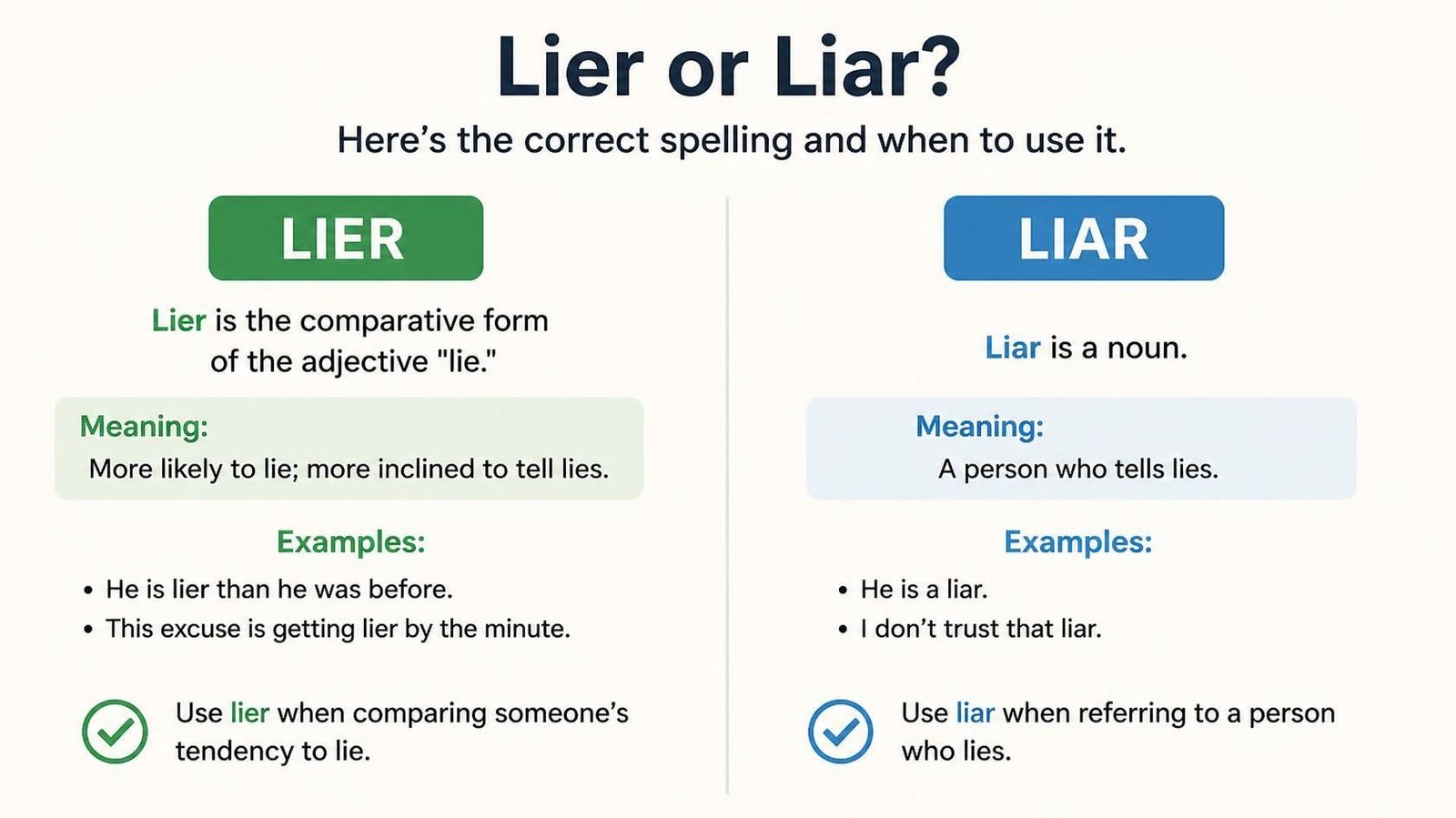
Liar is the right spelling for a person who tells lies.
Lier is a real but rare word with a different meaning.
Quick Answer
Use liar when you mean a dishonest person.
That’s the correct spelling of liar in standard English spelling.
Lier isn’t invented, but it almost never fits.
If you’re describing someone who tells lies, write liar and move on.
Table of Contents
- Meaning at a Glance
- What Does Lier or Liar Mean?
- Why Do People Search for Lier or Liar?
- The Deeper Meaning of Lier or Liar
- Background and Origin
- Contexts Where Lier or Liar Is Used
- Usage Across Different Platforms
- Examples in Everyday Life
- When Should You Use Liar?
- When Should You Avoid Using Lier or Liar?
- Common Misconceptions About Lier or Liar
- Common Mistakes When Using Lier or Liar
- Similar Words and Alternatives
- How to Use Liar in a Sentence
- Lier or Liar in Different Languages and Cultures
- Lier or Liar in Online Conversations and Social Media
- Popularity and Trends Over Time
- Quick Memory Tricks for Liar
- Featured Snippet Summary
- Trusted References
- Frequently Asked Questions
- Conclusion
Meaning at a Glance
Here’s the whole lier vs liar meaning in one small table.
Skim it first, then read on for the details.
| Word | Meaning | How common | Example |
| Liar | A person who tells lies | Very common | “He’s a liar.” |
| Lier | One who lies down, as in “lier in wait” | Very rare | “A lier in wait” |
What Does Lier or Liar Mean?
Both words come from the verb lie, but they point to different actions.
One lie is about false statements, and the other is about reclining.
That split is why the difference between lier and liar feels so confusing.
The spelling changes, and so does the idea behind it.
What Does Liar Mean?
The liar meaning is simple: a person who says things they know aren’t true.
It’s a noun tied to deliberate deception.
Dictionaries like Cambridge Dictionary and Merriam-Webster carry this liar definition.
It’s the one you’ll meet in daily talk.
What Does Lier Mean?
The lier meaning is much narrower.
It names someone or something that lies down or rests.
You’ll spot it in the old phrase “lier in wait.”
Some dictionaries list it as a rare English word, so is lier a word? Yes, just not a useful one here.
A Simple Example
Picture a friend who says he finished the report when he hadn’t.
He’s a liar.
Now picture a hunter crouching in the grass, waiting for a deer.
An older writer might call him a lier in wait.
Why Do People Search for Lier or Liar?
Most people search because the word looks wrong either way.
Spell checkers don’t always flag lier, so the doubt sticks.
Others are English language learners who expect word formation to follow the verb.
Lie plus er feels logical, and that logic trips plenty of smart people.
The Deeper Meaning of Lier or Liar
A liar isn’t just someone who got a fact wrong.
It carries intentional falsehood, and that’s what makes the word so heavy.
That weight touches trust, betrayal, and concealment.
Call someone a liar and you’re questioning their character, not their memory.
Background and Origin
The word has Old English roots.
It grew from a form linked to the verb for telling a falsehood, and Middle English spellings shifted a lot over time.
Spelling wasn’t fixed back then.
Writers used several endings until printing and dictionaries settled on liar.
Why Does Liar Have an “A”?
English has several endings for people who do things.
Some use er, some use or, and a few use ar.
Think of beggar, burglar, and liar.
They’re old words that kept their ar, so they break the usual spelling rules without breaking anything else.
Contexts Where Lier or Liar Is Used
You’ll see liar across many fields.
Lier barely shows up in any of them.
Art & Painting
Painters sometimes explore the idea that art itself is a beautiful lie.
The word liar appears in titles and critiques, never lier.
Photography
Photographers argue about edited images and whether a photo can mislead.
A doctored picture can make its maker a liar, which is why captions matter.
Literature
Fiction loves the unreliable narrator.
Readers call that narrator a liar once the story’s false information surfaces.
Movies & Documentaries
Thrillers and courtroom dramas lean on truth and lies.
Scripts write “liar” in dialogue because it sounds natural and clear.
Personal Development
Coaches say we sometimes lie to ourselves first.
In that setting, “liar” becomes a hard but honest mirror.
Business & Branding
Brands avoid the word because it feels like an attack.
They say misleading claims or unsupported claims instead, which keeps things professional communication friendly.
Education
Teachers use “liar” in grammar lessons on commonly confused words.
It’s a handy example for English vocabulary and correct word usage.
Social Media
Posts and captions use “liar” for drama and humor.
You’ll almost never see lier unless someone’s making a typo.
Usage Across Different Platforms
On blogs and news sites, liar shows up in headlines about false statements.
Editors usually choose a softer phrase unless facts are proven.
In texts and chats, people type fast and autocorrect saves them.
In formal writing, you slow down and check the dictionary definition first.
Examples in Everyday Life
Say your cousin swears he never touched the last slice of cake.
Chocolate on his shirt says he’s a liar.
Or a coworker claims she sent the file yesterday.
Email logs show she didn’t, so she told a lie, and you might call her a liar in private.
When Should You Use Liar?
Use liar whenever you mean a person who tells lies.
That covers speech, writing, jokes, and serious accusations.
It also covers the plural, liars.
Add an s and you’re done.
Examples
- “I don’t trust him, he’s a liar.”
- “Two liars stood in the room, and both blamed the dog.”
- “Nobody likes being called a liar.”
When Should You Avoid Using Lier or Liar?
Avoid lier unless you’re quoting the old phrase “lier in wait.”
Otherwise readers will think you made a common spelling error.
Also think twice before using liar in a heated moment.
It’s blunt, and it can end a conversation fast.
Common Misconceptions About Lier or Liar
A few myths keep this confusion alive.
Let’s clear them up one by one.
Misconception 1: Lier Is Always Wrong
Not quite.
Lier is a real word with a rare meaning.
Misconception 2: Liar Is a Misspelling of Lier
It’s the other way around.
Liar is the standard form for a dishonest person.
Misconception 3: Both Words Mean Exactly the Same Thing
They don’t.
One is about dishonesty, the other is about lying down.
Misconception 4: Liar Always Means a Habitual Liar
You can call someone a liar for a single lie.
A habit isn’t required, though repeated lies make the label stick harder.
Common Mistakes When Using Lier or Liar
Most slips come from guessing instead of checking.
Here are the ones I see most.
Mistake 1: Writing “Lier” for a Dishonest Person
This is the big one.
If the person tells lies, the word is liar.
Mistake 2: Assuming English Spelling Must Follow the Verb
English doesn’t always match a verb with a tidy ending.
Beggar and burglar prove it, and liar joins them.
Mistake 3: Using Liar Without Evidence
Calling someone a liar online can backfire.
If you can’t prove it, say the statement was untrue or misleading instead.
Mistake 4: Confusing Lie and Lay
Lie means to recline, and its past is lay.
Lay needs an object, as in “lay the book down,” and its past is laid.
Telling a falsehood is also lie, but the past is lied.
Same word, two jobs, and that’s why lie vs lay trips so many writers.
Similar Words and Alternatives
Want a fresher word than liar?
Try one of these synonyms, depending on the mood.
- Deceiver for someone who tricks others
- Fibber for a light, playful tone
- Fabricator for someone who invents details
- Fabulist for a teller of tall tales
- Falsifier for someone who alters facts or records
- Fraud for someone pretending to be what they’re not
How to Use Liar in a Sentence
Seeing liar in a sentence helps it stick.
Here are a few styles you can borrow.
Professional Writing
“The report labeled the claim false, but it didn’t call the speaker a liar.”
That keeps things fair and safe.
Creative Writing
“She smiled like a liar who’d rehearsed the truth in the mirror.”
It adds mood without extra fuss.
Social Media Caption
“Liar liar, my phone says 2% battery.”
A joke works best when it’s light.
Inspirational Quote
“A liar fools others once, himself forever.”
Make up your own twist and it’ll feel more yours.
Everyday Conversation
“You said you’d call back. Don’t be a liar now.”
Casual, direct, and clear.
Lier or Liar in Different Languages and Cultures
Every language has a word for it.
Spanish says mentiroso, French says menteur, German says Lügner, and Urdu says jhoota.
Interestingly, Lier is also a municipality in Norway.
That’s a name, not an English word, so don’t let it confuse you.
Lier or Liar in Online Conversations and Social Media
Online talk moves fast.
Typing lier by mistake is common, but people notice.
In comment threads, “liar” gets used as an accusation or a joke.
Context decides whether it reads as playful or aggressive.
Popularity and Trends Over Time
Across published English, liar appears far more often than lier.
You can check this yourself with Google Ngram Viewer or Google Trends.
Searches for the lier or liar spelling tend to spike when students write essays.
That points to simple spelling confusion, not a real rivalry between the words.
Quick Memory Tricks for Liar
Try this: liar ends like beggar and burglar.
All three name a person, and all three end in ar.
Another trick is to link it to “lie.”
The word starts with the lie, then adds ar for the person behind it.
Featured Snippet Summary
Liar is the correct spelling for a person who tells lies.
Lier is a rare word meaning one who lies down, and it’s seldom used today.
The plural is liars, and liar is a noun.
For a dishonest person, always write liar.
Trusted References
Don’t just take my word for it.
Check Cambridge Dictionary, Oxford Learner’s Dictionaries, and Merriam-Webster.
They define liar the same way.
Some also list lier as a rare form, which fits what we covered.
Frequently Asked Questions
Is “lier” or “liar” correct?
Liar is correct for a person who tells lies.
Lier is only right in rare, old uses.
Is lier a real word?
Yes, but it’s uncommon.
It refers to one who lies down, not a dishonest person.
Why is it spelled liar instead of lier?
English picked the ar ending for this word over time.
It’s a word origins quirk, not a rule you can guess.
Is liar an adjective or noun?
Liar is a noun.
For an adjective, use lying or dishonest.
What is the plural of liar?
The plural is liars.
Just add an s.
Is liar an insult?
Often, yes.
It accuses someone of deliberate deception, so use it carefully.
Can I use liar in formal writing?
You can, but be careful.
Unless you have proof, write about false statements instead of attacking a person.
What is the easiest way to remember liar?
Think beggar, burglar, liar.
All three end in ar and name a person.
Conclusion
So, lier or liar?
It’s liar nearly every time.
Now you know the meaning, the origin, and the traps.
Next time autocorrect hesitates, you won’t.
Did this clear things up for you?
Drop a comment with the spelling mix ups you see most, and share this with a friend who still types lier.
