

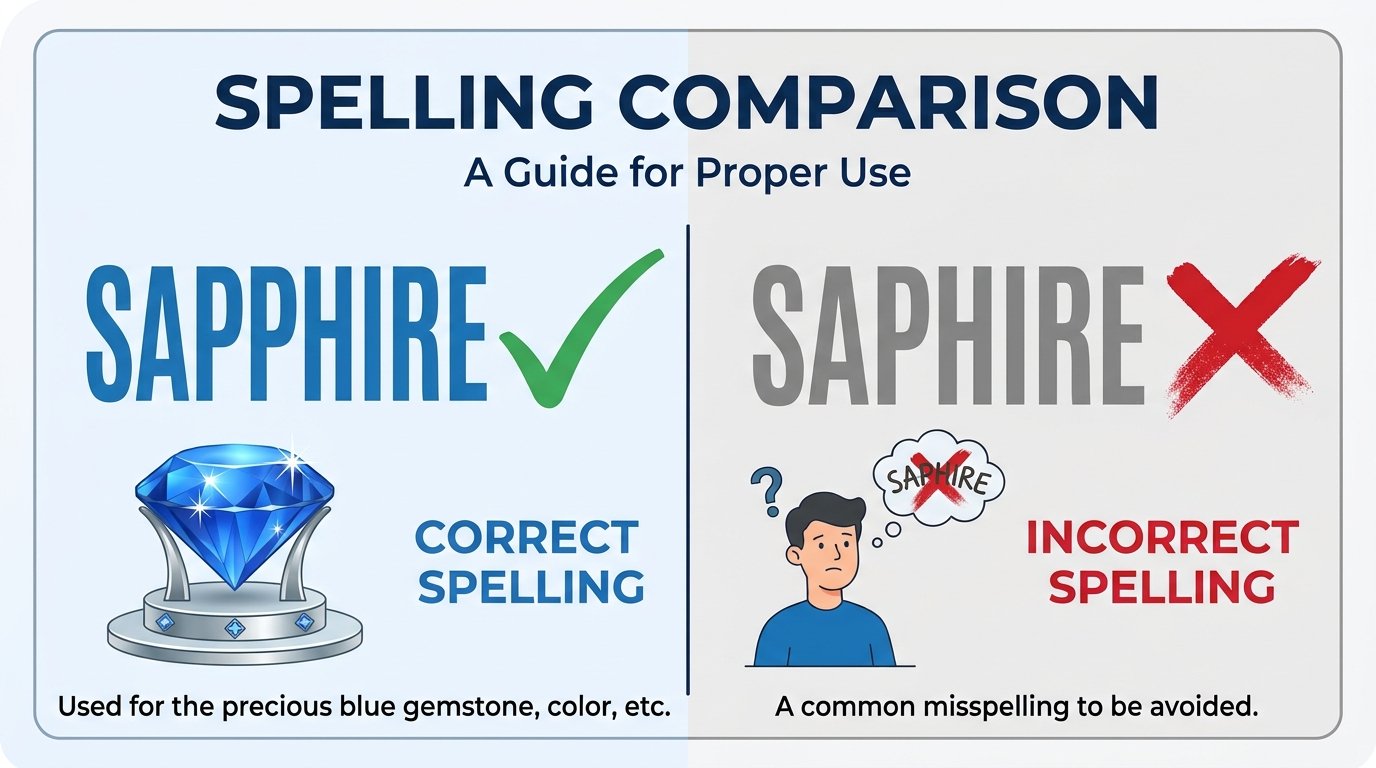
Have you ever wondered whether to write sapphire or saphire? These two spellings look similar, and they may seem equally reasonable at first glance. However, only one is accepted as the correct spelling in standard English.
The correct spelling is sapphire. It refers to a precious gemstone known for its beauty, durability, and rich blue color. The spelling “saphire” is a common misspelling and should be avoided in formal and informal writing.
Knowing the difference between sapphire and saphire can help you improve your spelling, write more confidently, and avoid mistakes in school assignments, emails, social media posts, and professional documents. This guide explains the meaning of sapphire, why people misspell it, where the word comes from, and how to remember its correct spelling.
Whether you are an English learner, a student, a writer, or someone who wants to improve everyday communication, understanding this small spelling difference can make your writing clearer and more professional.
What Does “Sapphire” Mean?
A sapphire is a precious gemstone that belongs to the corundum mineral family. It is widely recognized for its blue color, although sapphires can occur in several other colors, including yellow, pink, green, purple, and orange.
Sapphires are popular in jewelry because they are attractive and durable. They are commonly used in rings, necklaces, earrings, bracelets, and other decorative items. On the Mohs scale of mineral hardness, sapphire ranks 9 out of 10, making it one of the hardest natural gemstones.
The word sapphire can also have symbolic meanings. In different cultures, it is associated with wisdom, loyalty, sincerity, and elegance. For this reason, it frequently appears in descriptions of engagement rings, luxury products, birthstones, and meaningful gifts.
Examples:
- She received a beautiful sapphire ring for her birthday.
- The necklace features a deep blue sapphire.
- Sapphire is the traditional birthstone for September.
- The designer selected sapphire gemstones for the collection.
In each example, sapphire is spelled with two consecutive p’s and an e near the end.
Why “Saphire” Is Wrong
The spelling “saphire” is incorrect in standard modern English when referring to the gemstone. Although readers may understand what the writer means, dictionaries recognize sapphire as the standard spelling.
The mistake usually happens because people remember the sound of the word but not its exact letter sequence. English spelling does not always follow pronunciation, so familiar sounds can sometimes lead to incorrect written forms.
The difference is easy to see:
- Sapphire: Correct spelling.
- Saphire: Incorrect spelling in standard English.
For example, writing “She purchased a saphire necklace” introduces a spelling error. The correct sentence is “She purchased a sapphire necklace.”
Using the correct spelling matters because spelling errors can reduce the clarity and credibility of written communication. In professional settings, product descriptions, academic assignments, and online content, accuracy helps readers trust the information they receive.
Remember that a spell-checking tool may identify the error, but it is still helpful to understand the correct form yourself. Learning the spelling makes it easier to recognize and avoid the same mistake in the future.
Why People Misspell Sapphire or Saphire
People often misspell sapphire because the word contains a letter combination that is easy to forget. Its two consecutive p’s and final letter sequence can be confusing, especially for people who have learned English as a second language.
Several common reasons explain this mistake.
1. Remembering the sound instead of the spelling
Many writers spell words according to how they sound. When someone hears sapphire, they may remember its pronunciation but overlook the exact arrangement of its letters.
2. Forgetting the double p
One of the most common spelling errors is using only one p or replacing the second p with another letter. The correct spelling always includes two consecutive p’s.
3. Confusing similar-looking words
English contains many words with unusual spelling patterns. When people encounter a word they do not use frequently, they may create an incorrect spelling based on familiar patterns.
4. Typing too quickly
Typing mistakes can happen when writing messages, social media captions, product listings, or online articles. A writer may accidentally type saphire without noticing the missing p.
5. Limited exposure to the word
People who rarely read about gemstones may not have seen the word sapphire often enough to remember it automatically. Repeated reading and writing can help make the correct spelling familiar.
To avoid these mistakes, pay attention to the middle of the word. Remember that sapphire contains the sequence pph, followed by ire. Practicing the spelling in short sentences can also improve long-term recall.
Origin of the Word
The word sapphire has a long linguistic history. It entered English through historical forms of Latin and French, ultimately tracing back to the Greek word sappheiros. The Greek term was associated with a blue gemstone, although the precise gemstone referred to in some ancient sources is debated.
The word’s deeper history is commonly connected with the Hebrew sappir. Related forms appear in several ancient languages, reflecting the long history of gemstone trading and the cultural importance of precious stones.
Over time, sapphire became the established English spelling. Its modern form developed through historical language changes rather than through a simple relationship between pronunciation and individual letters.
Understanding this background helps explain why the spelling may not look completely intuitive. English has borrowed many words from other languages, and borrowed words often preserve spelling features that learners may find unfamiliar.
Today, sapphire is used in everyday English, jewelry descriptions, mineralogy, fashion, literature, and product marketing. Its spelling remains consistent in standard written English.
The alternative spelling saphire does not represent a recognized British or American variation. It is generally treated as a misspelling rather than a separate historical or modern English word.
British vs American English
British and American English sometimes use different spellings for the same word. For example, British English commonly uses “colour,” while American English uses “color.” Similarly, “centre” is standard in British English, whereas “center” is standard in American English.
However, the spelling of sapphire does not change between these varieties.
| English variety | Correct spelling | Incorrect spelling |
| American English | Sapphire | Saphire |
| British English | Sapphire | Saphire |
| Canadian English | Sapphire | Saphire |
| Australian English | Sapphire | Saphire |
Writers should use sapphire regardless of whether they follow American or British spelling conventions.
This consistency is particularly useful for international communication. If you are writing a product description for a U.S. audience, preparing a school assignment in the United Kingdom, or publishing an article for readers in Australia, the correct spelling remains the same.
Do not assume that saphire is acceptable simply because English spelling differs between countries. Regional spelling differences exist for certain words, but sapphire is not one of them.
For website owners and content writers, maintaining the standard spelling is also important for search relevance. People searching for sapphire jewelry, sapphire meaning, or sapphire gemstone information generally expect the recognized spelling. Correct usage supports readability and professional presentation.
When to Use Sapphire or Saphire
Use sapphire whenever you are referring to the gemstone or using the word in a related description. Since saphire is a misspelling, it should not be used as a substitute in standard writing.
Here are some situations in which sapphire is appropriate.
1. When describing jewelry
Use sapphire when discussing rings, necklaces, earrings, bracelets, or other accessories containing the gemstone.
Example: “The sapphire pendant looks elegant with a silver chain.”
2. When discussing gemstones
In educational, scientific, or informational writing, sapphire is the standard term for the gemstone.
Example: “Sapphire is a variety of corundum.”
3. When writing product descriptions
Online stores should use the correct spelling to describe jewelry, watches, decorative items, and other products.
Example: “This sapphire ring features a polished silver setting.”
4. When writing school assignments
Students should use sapphire in essays, vocabulary exercises, science projects, and other academic work.
Example: “Sapphire is one of the traditional birthstones associated with September.”
5. When publishing online content
Blog posts, social media captions, product reviews, and educational articles should use the standard spelling.
Example: “Learn how to choose a sapphire gemstone for a special occasion.”
If you accidentally write saphire, correct it before publishing or submitting your work. A simple proofreading step can prevent this error from appearing in your final text.
Common Mistakes
Spelling sapphire correctly becomes easier when you understand the mistakes people commonly make. The most frequent problem is changing or removing a letter from the middle of the word.
Typical mistakes:
- Writing saphire instead of sapphire: The most common error is replacing the second p with an h.
- Using one p instead of two: The correct word contains two consecutive p’s.
- Replacing the final e: The word ends with “ire,” not simply “er.”
- Assuming regional spelling differences apply: British and American English both use sapphire.
- Relying entirely on pronunciation: Hearing a word does not always reveal its exact spelling.
- Ignoring proofreading: A small typo can remain unnoticed in an otherwise well-written document.
One useful strategy is to divide the word into manageable parts: sap + phire. This is a memory aid, not an official linguistic division, but it can help you recall the correct sequence.
Another option is to write the word several times while saying the letters aloud. Visual repetition and active recall can make the spelling easier to remember.
Examples:
Incorrect: She bought a saphire bracelet for her mother.
Correct: She bought a sapphire bracelet for her mother.
Incorrect: The saphire is known for its beautiful blue color.
Correct: The sapphire is known for its beautiful blue color.
Incorrect: He chose a saphire engagement ring.
Correct: He chose a sapphire engagement ring.
Incorrect: Sapphire is spelled as saphire in British English.
Correct: Sapphire is spelled the same way in British and American English.
These examples show that the correction is straightforward. In each case, replacing the incorrect spelling with sapphire makes the sentence standard and accurate.
Everyday Examples
The spelling of sapphire can appear in many types of communication. Using the correct form consistently helps readers understand your message and creates a polished impression.
Emails:
Emails often include product recommendations, gift ideas, shopping questions, and business discussions. When referring to a gemstone, use sapphire.
Example 1:
Subject: Gift Recommendation
“I’m considering a sapphire necklace as a birthday gift. Could you recommend a design that would suit everyday wear?”
Example 2:
“Thank you for sharing the details of the sapphire ring. I would like to learn more about its size and gemstone quality.”
Both examples use the correct spelling and communicate the message clearly.
Social Media:
Social media captions are usually short, but correct spelling still matters. A typo can distract readers from the message or make a product post appear less professional.
Examples:
- “A timeless sapphire ring for a special moment.”
- “Blue sapphire jewelry never goes out of style.”
- “Celebrating September birthdays with beautiful sapphire gemstones.”
- “A little sparkle with a classic sapphire pendant.”
If you use hashtags, you can also write tags such as #SapphireJewelry or #SapphireRing. Use the standard spelling in captions, hashtags, and product tags.
Professional Writing:
Professional writing requires consistent spelling, particularly in business documents, advertisements, reports, and product catalogs.
Examples:
- “The collection includes sapphire earrings and matching necklaces.”
- “Each sapphire gemstone is described according to its color and cut.”
- “The product catalog features a range of sapphire jewelry.”
- “Our latest design uses a blue sapphire as its central gemstone.”
For jewelry retailers, accurate spelling is especially important because product descriptions help customers identify and understand the items they are considering.
School Assignments:
Students may encounter sapphire in English vocabulary exercises, science lessons, geography projects, and reports about gemstones.
Examples:
- “Sapphire is a precious gemstone.”
- “The blue color of many sapphires comes from trace elements in the mineral.”
- “Sapphire is associated with the month of September as a traditional birthstone.”
- “The hardness of sapphire makes it useful for certain industrial applications as well as jewelry.”
When writing assignments, check unfamiliar words before submitting your work. Using the correct spelling demonstrates attention to detail and helps keep your writing accurate.
Usage Comparison Table
The following table summarizes the main differences between sapphire and saphire.
| Feature | Sapphire | Saphire |
| Spelling status | Correct | Incorrect |
| Standard dictionary usage | Accepted | Not accepted as the standard spelling |
| Meaning | A precious gemstone | No standard meaning as a spelling variant of the gemstone |
| American English | Correct | Incorrect |
| British English | Correct | Incorrect |
| Suitable for formal writing | Yes | No |
| Suitable for academic work | Yes | No |
| Suitable for product descriptions | Yes | No |
| Common reason for use | Standard spelling | Typographical or spelling error |
The key point is simple: sapphire is the correct spelling in standard English. The alternative form saphire should be corrected whenever it appears in ordinary writing.
If you are unsure, consult a reliable dictionary or use a spelling checker. However, learning the word’s letter pattern will help you recognize it without needing to check every time.
FAQs
1. Sapphire or Saphire: Which Is Correct?
Sapphire is the correct spelling in standard English. Saphire is a misspelling and should not be used when referring to the gemstone.
2. How Can I Remember the Spelling?
Remember that sapphire contains two consecutive p’s. Write the word a few times and use it in a sentence to reinforce the correct spelling.
3. Why Does Sapphire Have Double “P”?
The double p comes from the word’s established historical spelling. It is part of the standard English form and must be retained.
4. Is “Saphire” Ever Acceptable?
Saphire is not an accepted standard spelling of the gemstone. It may appear as a typo or as a deliberately chosen name or brand, but sapphire is the correct ordinary English word.
5. Does Pronunciation Affect Spelling?
Pronunciation can contribute to spelling mistakes because English spelling does not always match sounds perfectly. The best approach is to learn the established written form of each word.
6. Is Sapphire Always Blue?
No. Blue is the best-known sapphire color, but sapphires also occur in yellow, pink, green, purple, and other colors. Red corundum is generally classified as ruby.
7. Can I Use Sapphire in Formal Writing?
Yes. Sapphire is appropriate for academic papers, business documents, product descriptions, reports, and other formal writing whenever the gemstone is relevant.
Conclusion
The difference between sapphire and saphire is small, but only one spelling is correct in standard English. Sapphire is the accepted form used in dictionaries, academic writing, business communication, jewelry descriptions, and everyday conversations. Saphire is a common misspelling and should generally be avoided.
Remembering the double p is one of the easiest ways to prevent this error. You can also improve your spelling by reading carefully, practicing unfamiliar words, and proofreading your work before sharing it.
Whether you are writing an email, completing a school assignment, publishing an article, or describing a beautiful gemstone, choose sapphire every time. Consistent spelling makes your writing clearer, more accurate, and more professional.
