

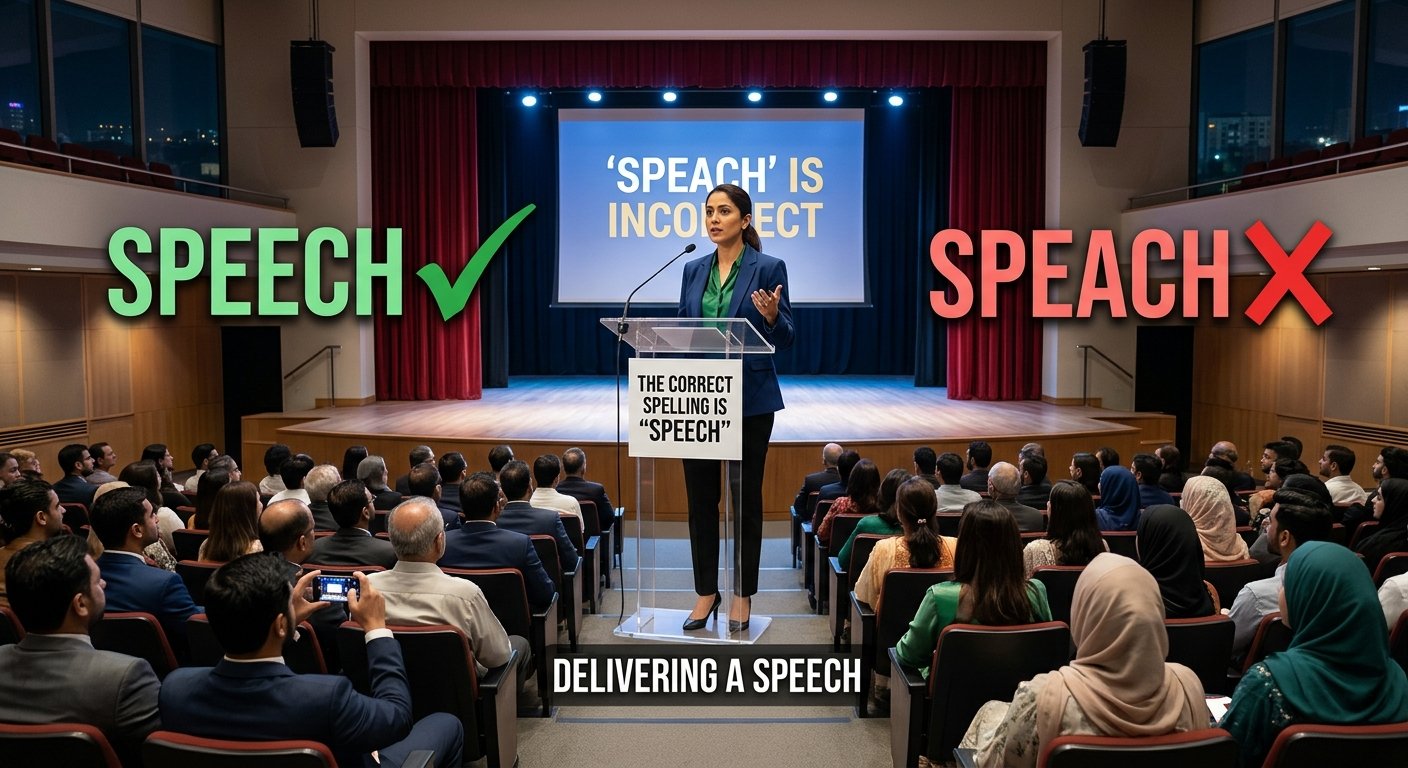
Speech is the correct spelling.
Speach is a common misspelling, and it isn’t a real English word.
You always write it with a double E, as in “give a speech” or “free speech”.
Have you ever typed it fast and wondered if that red squiggle was right?
Maybe you were writing a wedding toast or a school assignment.
Either way, you’re in good company, and this guide clears it up for good.
Speach or Speech: The Quick Answer
Speech is the only accepted spelling in standard English.
You’ll find it in every major dictionary, from Oxford to Merriam-Webster.
American and British writers spell it the same way, so there’s no regional twist.
Speach shows up on social media, in texts, and in rushed drafts.
It looks close enough to pass at a glance.
But it won’t pass an editor, a teacher, or a hiring manager.
Here’s the simple rule to remember.
If you mean talking, a talk, or the way someone speaks, write speech.
There’s no situation where “speach” is the better pick.
Why Do People Write “Speach”?
The mix up comes from sound, not carelessness.
Many English words spell the long E sound with “ea”, like teach, reach, and beach.
Your brain sees that pattern and applies it to speech without asking.
The verb “speak” adds to the confusion.
It has an “ea” in it, so the noun feels like it should too.
That’s a fair guess, but English doesn’t always play fair.
Fast typing makes it worse.
Autocorrect can also change your word before you notice.
So a spelling error like this is more common than you’d think.
What Does Speech Mean?
Speech is a noun with a few related meanings.
The most common one is the ability to speak or express thoughts in spoken words.
A toddler learning to talk is developing speech.
It also means a formal talk given to an audience.
Think of a best man’s toast, a graduation address, or a political talk.
In this sense, you “deliver” or “give” a speech.
A third meaning covers a person’s manner of talking.
You might say someone has slow speech or clear speech.
Context tells you which meaning the writer wants.
Where the Word Speech Comes From
The word has deep roots in Old English.
It grew from “spæc” or “spǣc”, which connects to the verb “sprecan”, meaning to speak.
Over centuries, the spelling settled into the form we use now.
This history explains the shape of the word.
English often changes a vowel when a verb becomes a noun.
That’s why the noun isn’t spelled like the verb.
If you like etymology, this one’s a neat example.
You can see how everyday words carry old patterns inside them.
It also shows why “speach” never had a historical claim.
Speech vs Speak: Why the Vowels Change
Here’s a pattern worth knowing.
Many English nouns change their vowel from the matching verb.
Speak becomes speech, and the “ea” turns into “ee”.
Other pairs work the same way.
Breed gives you breadth, long gives you length, and sing gives you song.
Speak and speech belong to that same family.
So don’t try to copy the verb’s spelling.
Treat the noun as its own word with its own shape.
That small shift saves you from the usual mistake.
Easy Tricks to Spell Speech Right Every Time
Memory tricks work best when they’re silly.
Try this one: speech and speed both start with “spee”.
If you can spell speed, you can spell speech.
Here’s another quick option.
Picture two people whispering, and each one is a lowercase “e” leaning in.
Two E’s, two speakers, one word.
You can also use this short checklist:
- Say the word slowly and notice the “ee” sound
- Remember “spee” opens both speed and speech
- Finish with “ch”, just like in “teach” and “each”
- Read it once more before you hit send
Speech Examples in Real Sentences
Seeing the word in action helps it stick.
Read these examples out loud and notice how natural they sound.
Each one uses a different meaning.
- “Her speech at the wedding made everyone laugh and cry.”
- “He lost his speech for a moment when the lights came on.”
- “The coach gave a short motivational speech before the final.”
- “My niece is in speech therapy to help with her r sounds.”
- “Freedom of speech protects your right to share opinions.”
Notice that none of these work with “speach”.
Swap it in and the sentence looks off right away.
That’s your quick test when you’re unsure.
Types of Speech You’ll Hear Most
Not every speech has the same goal.
Speakers usually pick one purpose and build around it.
Knowing the types helps you write and listen better.
Here are the main ones:
- Informative speech: teaches the audience something new
- Persuasive speech: tries to change a belief or inspire action
- Demonstration speech: shows how to do something step by step
- Entertaining speech: keeps people smiling, like a toast
- Special occasion speech: marks an event, like a retirement or award
A good speaker keeps the purpose clear from the first line.
If you try to do everything, the audience gets lost.
Pick one goal and stay with it.
Common Phrases That Use Speech
English loves this word, and it shows up in many set phrases.
Learning them boosts your vocabulary and your confidence.
Here are the ones you’ll meet most.
Figure of speech means a phrase used for effect, not literally.
“It’s raining cats and dogs” is a classic example.
Freedom of speech is the right to express your views without fear of punishment.
Direct speech repeats someone’s exact words inside quotation marks.
Indirect speech reports what they said without quoting it.
Parts of speech are the categories like nouns, verbs, and adjectives.
Other Spelling Mistakes Around Speech
“Speach” isn’t the only slip people make.
A few related words trip writers up too.
This table shows the wrong forms and the right ones.
| Wrong | Right | Quick note |
| speach | speech | Double E, not “ea” |
| speaches | speeches | Plural adds “es” |
| speachless | speechless | Keep the double E |
| spech | speech | Don’t drop the second E |
| speeche | speech | No extra E at the end |
Notice that the plural is speeches, with “es” at the end.
That’s because the word ends in “ch”, which takes “es”.
Same rule as church and churches.
Does a Spell Checker Catch “Speach”?
Most of the time, yes.
Word processors and phone keyboards flag it with a red underline.
They usually suggest the right fix too.
But you shouldn’t trust tools blindly.
Autocorrect sometimes picks the wrong word, and rushed clicks make it worse.
A quick proofreading pass still matters.
Try reading your text aloud before publishing.
Your ear catches things your eyes skip.
It takes ten seconds and saves you the embarrassment.
How to Write a Speech That Sticks
Now that you can spell it, let’s use it well.
A great speech starts with one clear message.
Ask yourself what you want people to remember tomorrow.
Then build a simple structure:
- Open with a hook, like a question or a short story
- Share two or three main points, no more
- Back each point with an example
- Close with a line that people can repeat
Keep your sentences short and your tone natural.
Write the way you’d talk to a friend over coffee.
Formal words make a speech feel stiff.
Tips for Nervous First Time Speakers
Almost everyone feels nervous before a talk.
That’s normal, and it doesn’t mean you’ll do badly.
Some butterflies can even sharpen your focus.
Practice out loud at least three times.
Record yourself on your phone and listen back.
You’ll spot filler words and rushed parts quickly.
On the day, breathe slowly and pause between ideas.
Silence feels long to you, but it feels powerful to the audience.
Smile at one friendly face and speak to that person.
Quick FAQs About Speach or Speech
Is speach ever correct?
No, it isn’t correct in any dialect of English.
Always use speech.
What’s the plural of speech?
The plural is speeches.
For example, “The senator gave three speeches this week.”
How do you pronounce speech?
It sounds like “speech”, rhyming with “teach”.
The long E sound is the same, even though the spelling differs.
Is speech a verb?
No, it’s a noun.
The verb form is speak.
Final Thoughts
So, speach or speech?
It’s speech every time, with a double E and a “ch” at the end.
Keep the “speed” trick in your back pocket and you’ll never miss it again.
Did this clear things up for you?
Drop a comment with a spelling pair that always trips you up.
And if a friend keeps writing “speach”, share this with them. They’ll thank you later.
