

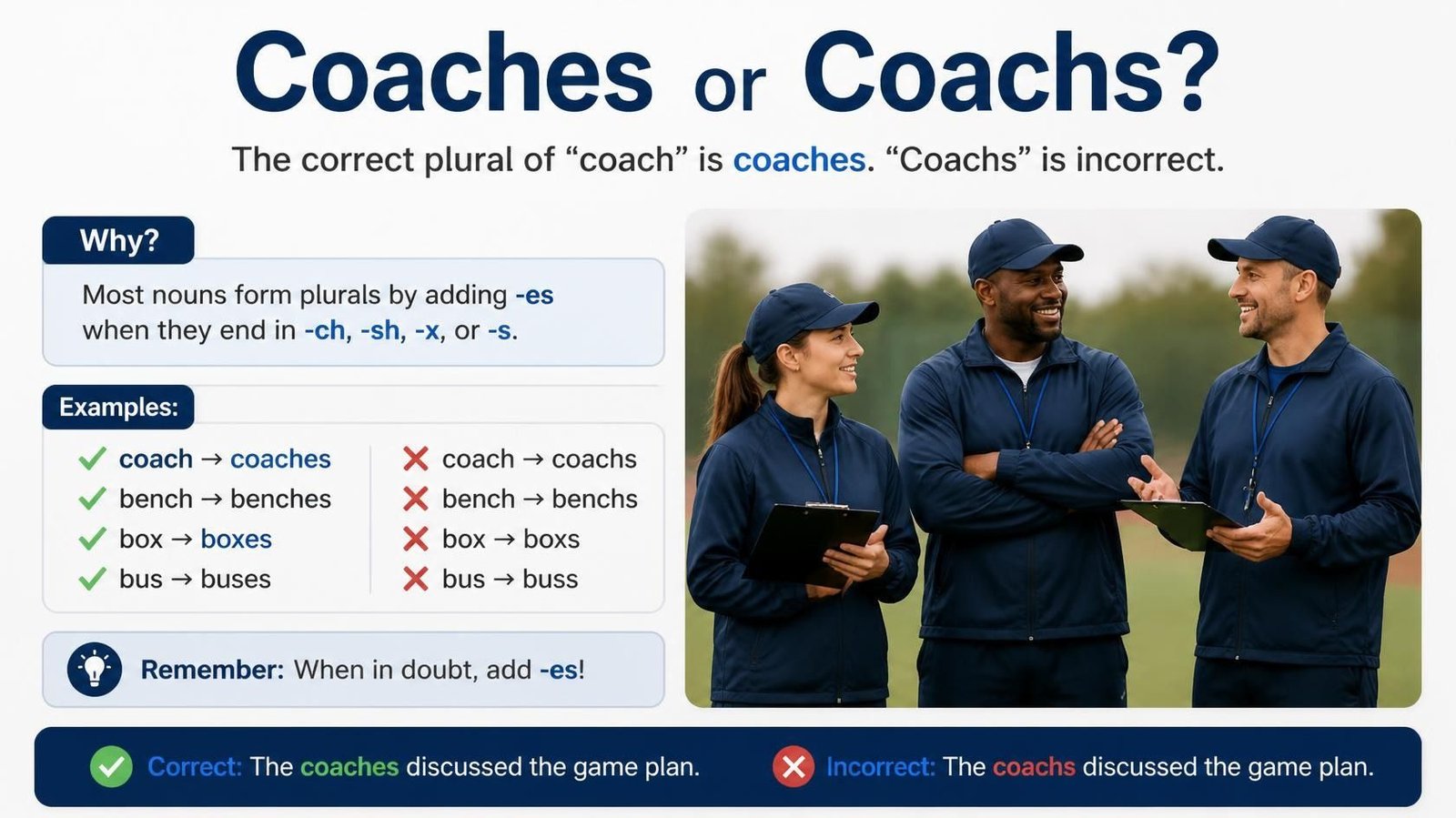
Have you ever stared at a sentence and wondered where the apostrophe goes?
You type “the coaches whistle” and something just feels off.
You’re not alone, and the fix is simpler than it looks.
Coaches means more than one coach, while coach’s shows something belongs to one coach.
This guide breaks down the spelling difference in plain talk.
You’ll get real examples, quick tricks, and the mistakes people make most.
Coaches or Coach’s – Quick Answer
Here’s the short version.
Use coaches when you mean more than one coach. Use coach’s when something belongs to one coach.
Now meet the third form, coaches’.
It’s the plural possessive, and it shows that something belongs to multiple coaches.
Here’s a quick look:
- Coaches attended the workshop. (plural, no ownership)
- The coach’s whistle hung on the fence. (one coach owns it)
- The coaches’ meeting starts at noon. (several coaches share it)
The Origin of Coaches or Coach’s
The word coach has a surprisingly bumpy history.
It traces back to a Hungarian village called Kocs, famous for its fast carriages.
The word traveled through French and landed in English around the 1500s.
Back then, a coach was a horse drawn carriage, nothing to do with sports teams.
Things changed in the 1830s.
Oxford students used the word as slang for a tutor who “carried” them through exams, and the sports meaning followed later in the 1800s.
The apostrophe has its own story.
Old English added an ending to show ownership, and writers later used the apostrophe to mark the missing letter.
That’s why coach’s carries one.
It’s a small leftover from centuries of English usage.
British English vs American English Spelling
Here’s the good news.
British English and American English handle this one the same way.
UK English and US English both write coaches for the plural.
Both write coach’s for the singular possessive and coaches’ for the plural possessive.
So where do the grammar differences come from?
They show up around the word, not inside it.
For example, a British writer might call a long distance bus a coach.
So “the coaches left at dawn” could mean buses, not people, which makes context matter even more.
Regional usage also affects how organizations write their names.
You’ll see “Coaches Association” with no apostrophe in plenty of British spelling and American spelling guides, because the word is descriptive, not possessive.
If you want a deeper look at English punctuation across regions, check a style guide your readers trust.
Most schools and newsrooms publish one.
Which Spelling Should You Use?
Ask yourself two quick questions.
First, how many coaches are you talking about?
Second, does something belong to them?
If you’re just counting people, pick coaches.
Example: “Three coaches joined the training session.”
If one person owns the thing, pick coach’s.
Example: “The coach’s advice changed my whole season.”
If several people own it together, pick coaches’.
Example: “The coaches’ feedback helped every athlete improve.”
Here’s a simple test you can run anywhere:
- Swap in “of the coach” and see if the sentence still works.
- Count the people involved.
- Look at the end of the word before you add the apostrophe.
How to Remember Coaches vs Coach’s
Memory tricks beat memorizing rules.
Try this one: the apostrophe sits right after the owner.
One owner means coach’s, with the apostrophe before the s.
Many owners means coaches’, with the apostrophe after the s.
Another trick is to picture a whistle.
One whistle on one lanyard is a coach’s whistle, and a rack of whistles in a staff room belongs to the coaches’ office.
Still unsure?
Read the sentence out loud and ask who owns what.
Common Mistakes with Coaches or Coach’s
The biggest slip is adding an apostrophe to a plain plural.
“Our coach’s arrived early” is wrong, because nothing belongs to anyone there.
The second slip is the reverse.
“The coaches plan is ready” drops the apostrophe and hides the ownership.
Then there’s coaches’s.
Most style guides call it incorrect for the plural possessive of coach, so stick with coaches’.
Here’s a quick list of common writing errors to watch for:
- Using an apostrophe + s on a regular plural
- Forgetting the apostrophe on a possessive form
- Mixing up singular reference and plural reference in one sentence
- Writing coaches’s instead of coaches’
These writing mistakes feel small.
However, they can hurt sentence clarity and make a professional email look rushed.
Why Coaches and Coach’s Get Confused
Pronunciation plays a big part.
In spoken English, “coaches” and “coach’s” sound almost identical.
Your ear can’t tell the difference, so your eyes have to.
That’s where proofreading earns its keep.
There’s another reason.
Plural and possessive forms both add an s sound, and the apostrophe is the only clue left.
Many people also learned the rule once and never revisited it.
A quick refresher fixes grammatical confusion fast.
Coaches or Coach’s in Everyday Examples
Let’s make it real.
Picture a high school gym on a Tuesday night.
“The coaches stayed late to plan Friday’s game.”
That’s a plural noun, nothing owned.
“The coach’s strategy relied on fast breaks.”
One coach owns the strategy.
“The coaches’ meeting ran long because the schedule changed.”
The meeting belongs to the whole coaching staff.
Here are a few more:
- The coach’s plan for the new sports season was simple.
- Our coaches attended a weekend coaching workshop.
- The coaches’ feedback went straight into each player’s folder.
- A coach’s whistle can silence a loud gym.
You’ll see the same patterns in emails, social media posts, and school writing.
Once you spot them, you can’t unsee them.
Coaches’ Meeting or Coaches Meeting?
Here’s a question that trips up even careful writers.
Do you need an apostrophe in “coaches meeting”?
Some style guides treat “coaches” as a descriptive word.
In that case, you’d write “coaches meeting” with no apostrophe, much like “teachers college.”
Others prefer the possessive, since the meeting belongs to the coaches.
Both approaches exist, so pick one and stay consistent.
If you’re writing for professional documents, follow the style guide your company or school uses.
If there isn’t one, choose coaches’ for ownership and stay steady.
Coaches or Coach’s – Google Trends & Usage Data
I can’t pull live numbers for you, so I won’t invent any.
You can check Google Trends in about thirty seconds and see the real picture.
Here’s what’s worth looking for.
Grammar searches like this tend to rise around school semesters and sports seasons, when people write schedules, newsletters, and team announcements.
Compare “coaches or coach’s” with “coaches vs coach’s” and “coaches’.”
You’ll learn which phrasing your readers actually type.
A few quick tips for reading the data:
- Look at at least twelve months, not one week.
- Compare regions, since UK English and US English readers may search differently.
- Check related queries for ideas you can answer in your own writing.
Then use that insight.
It helps you match what readers want and keep your content fresh.
Comparison Table: Coaches vs Coach’s
Sometimes a table says it faster.
Here’s a side by side look at all three forms.
| Form | Type | What It Means | Example |
| Coaches | Plural noun | More than one coach | Two coaches arrived early. |
| Coach’s | Singular possessive | Belongs to one coach | The coach’s whistle is missing. |
| Coaches’ | Plural possessive | Belongs to multiple coaches | The coaches’ meeting is at noon. |
Bookmark this table.
It’s handy for educational writing, sports writing, and any quick check before you hit send.
Quick Proofreading Checklist
Before you publish, run this fast check.
It takes under a minute and saves you from embarrassing slips.
Ask yourself these questions:
- Am I referring to multiple coaches or just one?
- Does anything show ownership in this sentence?
- Is the apostrophe in the right spot?
- Would a reader catch the meaning on the first read?
Good proofreading keeps your clear communication sharp.
It also builds trust, since readers notice careful writing.
FAQs
Can I use coach’s for more than one coach?
No. Coach’s is for one coach only. For several coaches who own something, use coaches’.
What’s the difference between coaches and coach’s?
Coaches is a plural, so it just counts people. Coach’s shows that something belongs to one coach.
How do I remember coaches vs coach’s?
Look at who owns the thing. One owner puts the apostrophe before the s, and many owners put it after.
Conclusion
You now have the full picture.
Coaches counts people, coach’s shows one owner, and coaches’ shows shared ownership.
Remember that British English and American English follow the same rule here.
So you can write with confidence in any grammar rules setting.
Keep the checklist close and read your sentences out loud.
Small fixes make your writing feel polished and professional.
Did this clear things up for you?
Drop a comment with the sentence that always trips you up, and share this guide with a teammate who writes team emails.
