

You’ve probably typed a word, stared at it, and thought “that looks wrong.”
It happens to everyone.
“Lable” is one of those words that looks almost right.
So which one is correct?
Let’s sort it out in plain words.
By the end, you’ll never second guess it again.
Lable or Label – Quick Answer
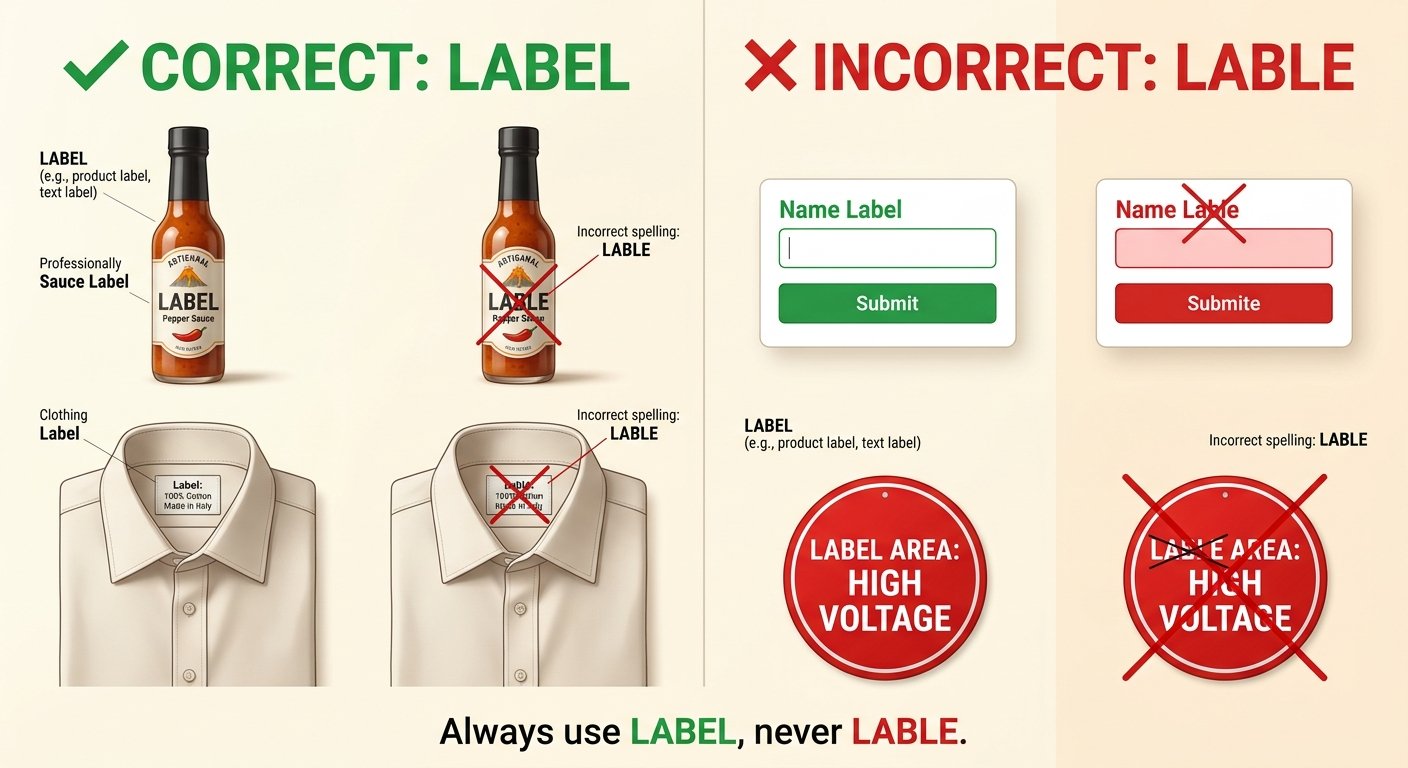
Label is the correct spelling.
“Lable” is a common misspelling, and no dictionary accepts it.
You can use “label” in every country and every style of writing.
Here’s why the mistake happens.
Many words end in “ble,” like table, cable, and stable.
Your brain expects the same pattern, so it flips the last letters.
The fix is simple.
The word is L + A + B + E + L.
It starts and ends with the same letter, which makes it easy to remember.
The Origin of Label
The word “label” has a long history.
It comes from Old French, where it meant a ribbon or a narrow strip.
That older word likely has Germanic roots.
In the Middle Ages, a label was a thin strip of cloth or parchment.
People attached it to documents to hold a seal.
Over time, the word moved from “strip” to “tag” or “name tag on an item.”
Today, a label can be paper, plastic, or even a digital tag.
Some people use it as a verb, like “label the folder.”
Some use it as a noun, like “read the label.”
British English vs American English Spelling
Here’s the good news.
Label is spelled the same way in British English and American English.
The base word never changes.
The small difference shows up when you add endings.
British writers usually double the “l” in the past tense and the present participle.
Americans usually keep it as a single “l.”
It follows the same spelling rule you see in “travelled” and “cancelled.”
So if you know those words, you already know this one.
Only the endings change by region, never the base word.
Which Spelling Should You Use?
For the base word, always write label.
It works everywhere, from London to Los Angeles.
There’s no wrong answer here, as long as you skip “lable.”
For the endings, think about your reader.
In the United States, write “labeled” and “labeling.”
In the United Kingdom, Canada, Australia, and New Zealand, write “labelled” and “labelling.”
If you write for a global audience, pick one style and stay with it.
Many international brands choose American spelling because it’s shorter.
For work emails, resumes, and reports, follow your company’s style guide.
Spelling Forms at a Glance
A quick view helps a lot here.
Check which form fits your situation.
- Base word: label (British and American)
- Past tense: labelled (British) and labeled (American)
- Present participle: labelling (British) and labeling (American)
- Plural noun: labels (both)
- Common misspelling: lable (wrong everywhere)
Notice that the “wrong” row never changes.
No region, style guide, or school accepts it.
That’s the easiest way to spot the pattern.
Common Mistakes with Label
Even careful writers slip up with this word.
Let’s look at the usual traps and how to fix them.
Seeing the errors makes them easier to avoid.
Mistake 1: “Please check the lable on the bottle.”
Fix: “Please check the label on the bottle.”
Just swap the last two letters back.
Mistake 2: “I lableled the boxes yesterday.”
Fix: “I labeled the boxes” (US) or “I labelled the boxes” (UK).
Spell the base word right first, then add the ending.
Mistake 3: Mixing styles in one document.
Using “labeled” in one paragraph and “labelled” in the next looks sloppy.
Pick one style and keep it all the way through.
Mistake 4: Confusing “label” with “lapel.”
A lapel is the folded flap on a jacket collar.
A label is a tag.
Mistake 5: Writing “lables” as the plural.
The correct plural is “labels.”
Add the “s” to the right spelling.
Mistake 6: Spelling “white label” wrong.
It’s a white label product, never a “white lable” product.
Brands and sellers see this error often.
An Easy Trick to Remember the Spelling
Here’s a memory trick that works for most people.
Look inside the word and you’ll find “able.”
So, L + able = label.
Say it out loud if you need to.
If you can say “able,” you can spell “label.”
The “able” part sits in the middle, not at the end.
Another tip is to picture the word as a mirror.
The first and last letters match, and the “able” sits in between.
That image sticks in your head longer than a rule.
Label in Everyday Examples
Seeing a word in real sentences makes it stick.
Here are a few you might use today.
Notice how natural each one sounds.
- “Always read the label before taking any medicine.”
- “She labeled every jar in her pantry.”
- “The label on this jacket says dry clean only.”
- “He didn’t like the labels people gave him.”
- “We’re labelling the shipping boxes for tomorrow.”
Did you spot the two “label” meanings?
One is a physical tag on a product.
The other is a word or title placed on a person or idea.
People use the word in many parts of life.
You’ll see it on food packages, clothes, and file folders.
You’ll also hear it in music, where a record label signs artists.
Label as a Noun and a Verb
“Label” works in two ways.
As a noun, it’s the tag itself, like “the label on the bottle.”
As a verb, it’s the action, like “I need to label this box.”
The spelling of the base word stays the same in both.
The verb form is where the regional endings appear.
That’s why “labeled” and “labelled” show up so often.
Knowing the role of the word helps you pick the right form.
If you’re talking about the action in the past, add the ending.
If you’re talking about the tag, use the plain word.
Label – Google Trends & Usage Data
Spelling mistakes show up clearly in search behavior.
People type “lable” into search bars all the time, often by accident.
Search engines usually correct it and show results for “label.”
You can check this yourself.
Open Google Trends and compare “lable” with “label.”
The gap is huge, because “label” is used far more widely.
The same tool also shows regional patterns.
You’ll see American spelling dominate in the United States.
Meanwhile, “labelled” appears more in the UK and other Commonwealth nations.
Common Phrases Using “Label”
The word appears in plenty of everyday phrases.
Many of them are worth knowing if you write or speak a lot.
Here are some of the most common.
- Record label: a company that produces and sells music
- Warning label: a notice about risks on a product
- Name label: a tag with someone’s name on it
- Price label: a sticker showing the cost
- Brand label: the maker’s name on a product
- Label maker: a small device that prints tags
- Mislabel: to put the wrong tag on something
Notice how the spelling stays the same in each one.
There’s never an “lable” hiding in any of them.
That’s a good sign you’re using the right form.
Comparison Table: Label vs Lable
Let’s put it all in one clear view.
This table shows the difference at a glance.
Save it if you write often.
| Word | Correct? | Where to Use It |
| Label | Yes | Everywhere |
| Lable | No | Nowhere |
| Labeled | Yes | American English |
| Labelled | Yes | British English |
| Labeling | Yes | American English |
| Labelling | Yes | British English |
| Lables | No | Nowhere |
Why Spell Check Matters for Brands and Businesses
A single wrong letter can hurt trust.
Imagine a product page that says “lable” in the description.
Customers may wonder what else was missed.
This matters most on product packaging, websites, and ads.
Small errors make a brand look rushed.
A quick proofread takes seconds and saves your reputation.
It’s also good for search results.
People searching for the right word find the right pages.
Clean spelling helps your content show up where it should.
FAQs
Is “lable” ever correct?
No.
It’s a misspelling in every form of English.
Is it “labeled” or “labelled”?
Both are correct.
Use “labeled” in American English and “labelled” in British English.
Is “label” British or American?
It’s both.
The base word is spelled the same in all English-speaking countries.
What’s the plural of label?
The plural is “labels.”
Just add an “s.”
What’s the difference between label and lapel?
A label is a tag on an item.
A lapel is the folded part of a jacket collar.
How do I stop misspelling it?
Remember that “able” sits inside “label.”
Think L + able, and you’ll get it right.
