

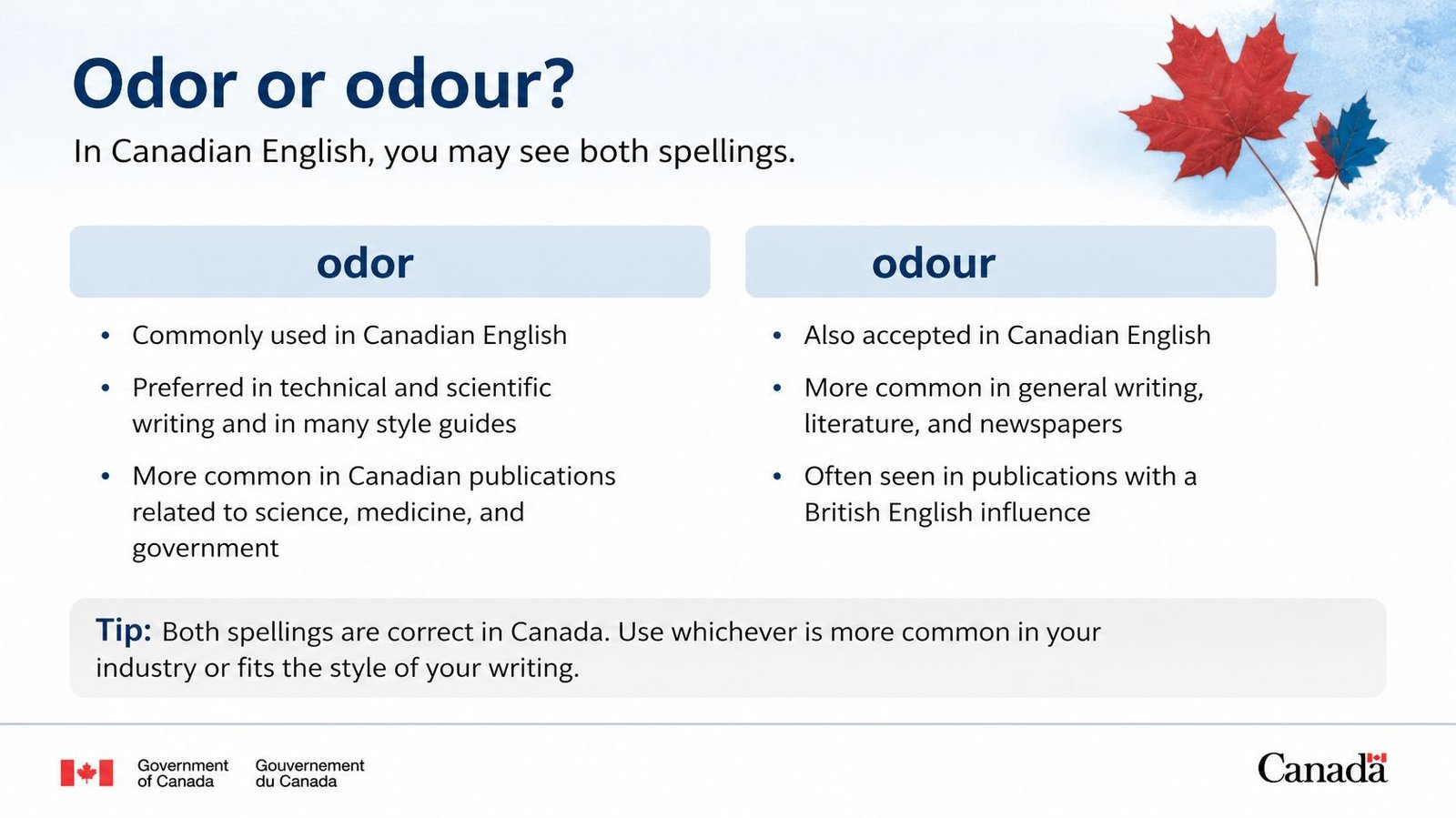
Have you ever wondered whether to write odor or odour in Canada? You are not alone. Both spellings are correct, and both refer to a smell. However, the preferred spelling depends on the type of English you are using.
In Canadian English, odour is generally the preferred spelling because Canadian spelling traditionally favours the -our ending in words such as colour, honour, and flavour. The spelling odor is standard in American English and is also understood in Canada. Canada’s Language Portal recommends odour for Canadian writing. <Cite refs={[“turn918900search0″,”turn918900search1”]}/>
If you are writing a school assignment, blog post, business document, or article for a Canadian audience, choosing odour is usually the best option. The most important thing is to follow your chosen spelling style consistently.
What Is the Difference Between Odor and Odour?
The main difference between odor and odour is spelling, not meaning. Both words describe a smell that a person can detect through the nose. The smell may be pleasant, unpleasant, weak, or strong.
The word odour is commonly preferred in Canadian and British English, while odor is the standard American spelling. For example, a Canadian writer might describe the odour of fresh flowers, while an American writer would usually describe their odor. Both sentences communicate the same idea. <Cite refs={[“turn918900search4″,”turn918900search6”]}/>
Odour: Canadian English
Odour is the recommended choice for most Canadian writing. It follows the traditional Canadian preference for words ending in -our rather than the American -or.
Examples:
- The odour of fresh bread filled the kitchen.
- A strange odour came from the basement.
- The flowers released a pleasant odour.
- The strong odour of garbage spread across the street.
- The bathroom had an unpleasant odour.
Use odour when writing Canadian-focused blog articles, educational content, formal documents, and general informational material.
Odor: American English
Odor is the usual American English spelling. It has the same meaning as odour and is widely recognized by English speakers in Canada.
Examples:
- The odor of fresh coffee filled the room.
- An unusual odor came from the refrigerator.
- The product helps control body odor.
- The odor disappeared after cleaning.
- The laboratory measured the odor of the chemical.
Use odor when following American English spelling conventions or when reproducing a product name, quotation, or official title that uses that spelling.
Which Spelling Should You Use in Canada?
If you are writing for Canadian readers, choose odour unless your organization, publication, or client requires American spelling. This recommendation follows guidance from Canada’s Language Portal, which generally favours -our endings in words such as odour. <Cite refs={[“turn918900search0″,”turn918900search1”]}/>
For example, a Canadian blog post should normally use the following sentence:
The unpleasant odour coming from the drain made the kitchen uncomfortable.
An American publication would more commonly write:
The unpleasant odor coming from the drain made the kitchen uncomfortable.
Both sentences are grammatically correct. The difference reflects regional spelling preferences rather than a difference in meaning.
Canadian English includes both British and American spelling conventions, so not every word follows the same pattern. A reliable Canadian dictionary or your organization’s style guide can help you decide which spelling to use. <Cite refs={[“turn918900search1″,”turn918900search3”]}/>
Odor vs. Odour: Comparison Table
The following table summarizes the main differences between these two spellings.
| Feature | Odour | Odor |
| Meaning | A smell | A smell |
| Preferred usage | Canadian English | American English |
| British English | Common | Less common |
| Pronunciation | Same in most contexts | Same in most contexts |
| Correct spelling | Yes | Yes |
| Recommended for Canadian articles | Yes | Use if required by style |
| Example | The odour was unpleasant. | The odor was unpleasant. |
The key takeaway is simple: odour is generally preferred in Canada, while odor is preferred in the United States. Neither spelling is universally wrong.
What Does Odour Mean?
The noun odour means a smell or scent that can be detected by the sense of smell. It can describe something pleasant, such as fresh flowers, or something unpleasant, such as spoiled food.
The word often appears in everyday conversations, product descriptions, scientific writing, and discussions about household cleanliness. Although people frequently use it to describe bad smells, an odour is not always unpleasant. <Cite refs={[“turn918900search6″,”turn918900search10”]}/>
Examples of Odour in Sentences
Here are some examples showing how to use odour correctly:
- The odour of freshly baked bread spread throughout the house.
- We noticed a strong odour coming from the kitchen sink.
- The flowers had a sweet and pleasant odour.
- The odour of damp clothing remained in the room.
- The cleaning product removed the unpleasant odour.
- A strange odour came from the old refrigerator.
- The basement developed a musty odour after the rain.
- The technician investigated the unusual odour in the building.
These sentences demonstrate that odour can describe many different types of smells.
What Are the Different Types of Odour?
Odours can be described according to their source, strength, and character. The following examples show how the word is used in everyday English.
1. Pleasant Odour
A pleasant odour is a smell that people generally find enjoyable. Flowers, perfumes, fresh food, and scented candles can produce pleasant odours.
Example: The pleasant odour of roses filled the garden.
2. Unpleasant Odour
An unpleasant odour is a smell that people generally dislike. Common examples include spoiled food, stagnant water, and unclean garbage bins.
Example: An unpleasant odour came from the garbage container.
3. Musty Odour
A musty odour is a stale smell often associated with damp or poorly ventilated spaces. It may occur in basements, closets, or rooms where moisture has accumulated.
Example: The old cupboard had a musty odour.
4. Body Odour
Body odour refers to the smell associated with the human body. It can develop when bacteria break down substances in sweat on the skin.
Example: Regular washing can help manage unwanted body odour.
5. Chemical Odour
A chemical odour is a smell associated with a chemical substance or product. Some chemicals can be harmful even when their smell is faint or absent.
Example: The worker noticed a chemical odour near the storage area.
If you detect a sudden, unexplained chemical or fuel-like smell, avoid trying to identify it by sniffing closely. Leave the area if you suspect a hazardous leak and contact the appropriate emergency or safety service.
Odour or Odor in Canadian English: Common Mistakes
Writers sometimes assume that one spelling is correct everywhere. In reality, regional English conventions influence many common words.
Here are several mistakes to avoid when choosing between odour and odor.
- Assuming odor is always incorrect: It is a standard American spelling, not a misspelling.
- Using both spellings in one article: Pick one spelling style and maintain consistency.
- Confusing spelling with meaning: Both forms describe the same thing.
- Ignoring your audience: Canadian readers generally expect Canadian spelling in locally focused content.
- Changing official wording: Preserve the original spelling in direct quotations, brand names, and official titles.
Remember that Canadian English is not identical to British or American English. It combines conventions from both, so checking a Canadian reference is useful when a spelling question arises. <Cite refs={[“turn918900search1″,”turn918900search3”]}/>
Related Words: Odour, Odorous, and Odourless
The spelling can change when a suffix is added to odour. This is an important detail for writers who want to avoid spelling mistakes.
| Word | Meaning | Example |
| Odour | A smell | The odour was noticeable. |
| Odorous | Having or producing a smell | The odorous material was removed. |
| Odourless | Having no noticeable smell | The odourless liquid was stored safely. |
| Odorant | A substance that produces or adds a smell | The odorant makes the gas detectable. |
| Odoriferous | Producing or carrying a noticeable smell | The odoriferous plants grew near the path. |
Important Canadian spelling rule: Although odour is generally preferred, the u is dropped in words such as odorous and odorant. Therefore, write odorous, not odourous. Canada’s Language Portal specifically explains this spelling pattern. <Cite refs={[“turn918900search0″,”turn918900search9”]}/>
Odor or Odour in Canada: Which One Is Best for SEO?
If you are writing SEO content for a Canadian audience, odour is a sensible primary spelling because it matches the Canadian preference. However, odor is also a relevant search variation because Canadian readers may encounter American spelling online.
You can optimize your article naturally by using the main spelling in the title, introduction, headings, and examples. Mention the alternative spelling where it helps answer the reader’s question.
Useful related keywords include:
- odor or odour in Canada
- Canadian spelling of odour
- odor vs. odour
- odour meaning
- correct spelling of odour
- Canadian English spelling
- odour vs. odor difference
- American spelling of odour
- pleasant odour
- unpleasant odour
- body odour meaning
- odourless meaning
Avoid repeating these keywords unnecessarily. Clear explanations, relevant examples, and accurate answers are more useful than keyword stuffing.
Frequently Asked Questions
1. Is it odor or odour in Canada?
Odour is generally preferred in Canadian English. Odor is the standard American spelling, and both words have the same meaning.
2. Is odour spelled with a u in Canadian English?
Yes. Canadian English generally favours odour, with a u, following the same pattern as colour, honour, and flavour.
3. Is odor wrong in Canada?
No. Odor is a recognized spelling and is widely understood in Canada. However, odour is usually the better choice for Canadian-focused writing.
4. What is the difference between odor and odour?
There is no difference in meaning. The words describe a smell, but odour is preferred in Canadian English and odor is preferred in American English.
5. How do you spell odour in Canadian English?
Spell it odour. For example, “The odour of fresh flowers filled the room.”
6. Is it body odor or body odour in Canada?
Body odour is the preferred Canadian spelling. Body odor is the American form.
7. Is odour or odor correct in Canadian academic writing?
Both are recognized, but odour is generally preferable when following Canadian English conventions. Always follow your university’s or publisher’s required style guide.
Conclusion
When deciding between odor or odour in Canada, choose odour for most Canadian English writing. It is the conventional Canadian spelling and matches words such as colour, honour, and flavour.
Use odor when writing in American English or when a specific style guide requires it. Both spellings are correct, and neither changes the meaning of the word.
For Canadian blogs, school assignments, websites, and professional documents, odour is the safest general choice. Stay consistent throughout your writing, and consult a reliable Canadian dictionary when you are unsure about regional spelling.
